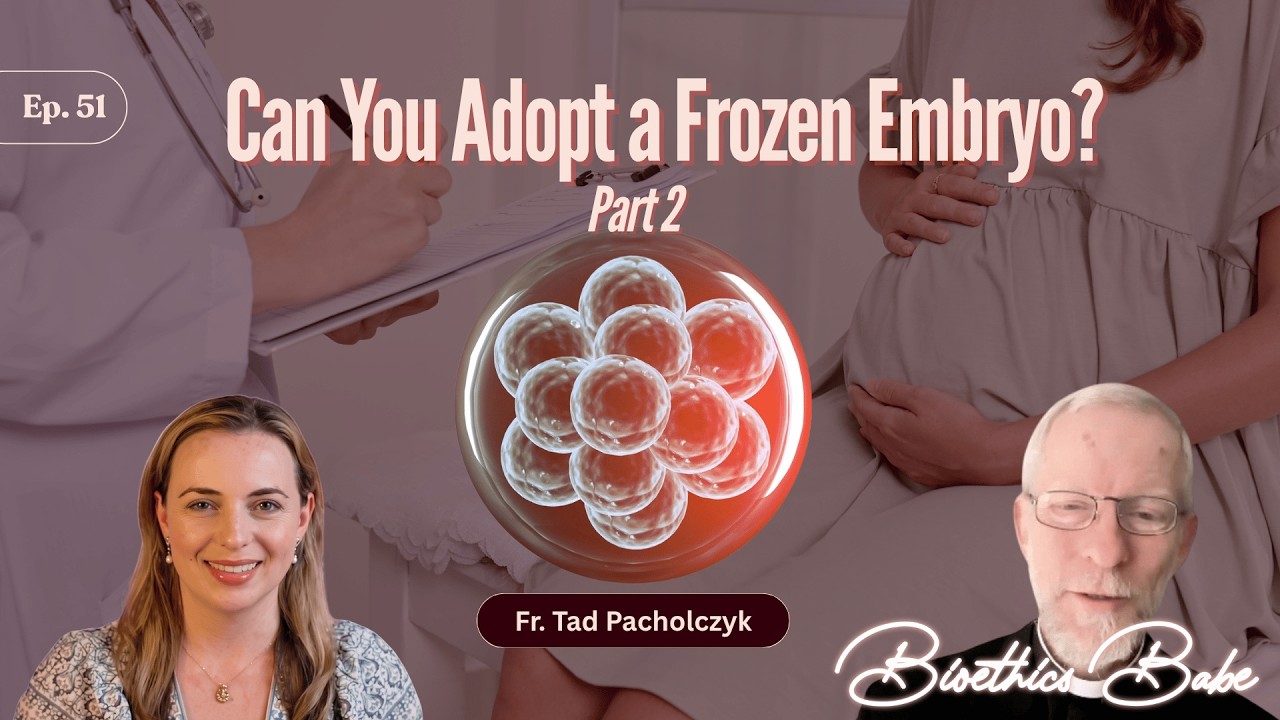
Is Embryo Adoption Actually Surrogacy? The Catholic Case Against It with Fr. Tad Pacholczyk
Originally published at Bioethics Babe- Categories
- Bioethics
What if saving a human life could itself be morally wrong?
More than 1.5 million human embryos are estimated to be frozen in the United States, many abandoned by the parents who created them through in vitro fertilization (IVF).
For some, the solution seems obvious: Why not adopt these embryos, give them a chance to be born, and welcome them into loving families?
But is embryo adoption an act of mercy, or another form of surrogacy?
In Part 2 of Bioethics Babe’s Frozen Embryo Series, Fr. Tad Pacholczyk makes the Catholic moral and theological case against embryo adoption, responding directly to the philosophical and theological arguments in its defense.
Fr. Tad served for more than 22 years as an ethicist, Director of Education, and Senior Ethicist at the National Catholic Bioethics Center.
We discuss:
- Why Fr. Tad argues that embryo adoption is a form of surrogacy
- Whether procreation ends at fertilization or continues through pregnancy and birth
- What Dignitas Personae and Donum Vitae teach about embryo adoption
- Whether the Catholic Church has definitively settled the debate
- Fr. Tad’s responses to the philosophical and theological arguments for embryo adoption
- Whether embryo transfer constitutes therapeutic, life-saving medical care
- The moral risks of thawing and transferring frozen embryos
- Whether artificial womb technology could provide an ethical alternative
- The heartbreaking question of what should happen to embryos left in cryopreservation
If destroying frozen embryos is wrong, leaving them frozen indefinitely is troubling, and embryo adoption is morally impermissible, what are we supposed to do?
This is Part 2 of a series presenting competing Catholic bioethical perspectives, following Dr. Melissa Moschella’s philosophical case for embryo adoption in Part 1.
Regardless of how a child is conceived or born, every human being possesses equal and inherent dignity.
For the latest episodes, episode resources, and general resources, please visit www.bioethicsbabe.com.
Please subscribe to my YouTube page: https://www.youtube.com/@BioethicsBabe
Thank you for tuning in!
XOXO,
Bioethics Babe
Follow BB on social media:
YouTube: https://www.youtube.com/@BioethicsBabe
Facebook: https://www.facebook.com/profile.php?id=61576554667052
Instagram: https://www.instagram.com/bioethicsbabe
X: https://x.com/bioethicsbabe
Listen to BB on Your Favorite Podcast Platform:
Apple Podcasts: https://podcasts.apple.com/us/podcast/bioethics-babe/id1841776855
Spotify: https://open.spotify.com/show/0sk6pK4vYfvkdyQh3vVO5m
Amazon/Audible: https://music.amazon.com/podcasts/168b2504-9269-4910-b3da-6e0b954da9de/bioethics-babe
iHeart: https://www.iheart.com/podcast/269-bioethics-babe-296039682/
RSS: https://rss.com/podcasts/bioethicsbabe/