Humanize From Discovery Institute's Center on Human Exceptionalism
Category

Science Journals

senior-male-researcher-carrying-out-scientific-research-in-a-52554426-stockpack-adobestock
Senior male researcher carrying out scientific research in a lab
Image Credit: lightpoet - Adobe Stock

Nature: Scientists Should Have to Register with Governments to Prevent “Misinformation”

Nature — the most prestigious science journal in the world — has editorialized in favor of requiring scientists to register with governments as a condition of participation in the sector. Here’s the context. South Africa has legislation pending that would require scientists to register with a government body or face significant legal consequences. Nature applauds the authoritarian idea. From the editorial (my emphasis): What do engineers, environmental-health officers and health-care workers have in common? These occupations can, in some instances, be practised only by people who have registered with a relevant professional body. This typically requires candidates to pass qualifying exams and adhere to a code of practice that includes sanctions for violations. The process is intended to create the highest standards of quality, Read More ›


women-man-and-hospital-bed-in-motion-blur-of-emergency-surge-551017210-stockpack-adobestock
Women, man and hospital bed in motion blur of emergency surgery, healthcare wellness or risk condition operation. Doctors, nurses and medical workers with patient in busy er, theatre room or teamwork
Image Credit: Anela/peopleimages.com - Adobe Stock

“Death by Organ Donation” Pushed in Prestigious Medical Journals

The late Fr. Richard John Neuhaus famously wrote that bioethicists “professionally guide the unthinkable on its passage through the debatable on its way to becoming the justifiable until it is finally established as the unexceptional.”

He was right. Radical bioethical policies don’t just appear like magic out of the ether. Controversial—even pernicious—ideas are often debated in bioethics and medical journals where few among the public ever see them. Then, if a general consensus is reached within the field, policies once considered “unthinkable” are “suddenly” elevated into the justifiable and become unexceptional public policy.

Here are just two examples. Legalizing assisted suicide was once way beyond the pale. Then, bioethicists began arguing in favor of such laws, after which hastened death became debatable, then justifiable, and now, in many jurisdictions, so unremarkable that many thousands of people have died by that method.

Read More ›
a-pair-of-glasses-rests-atop-a-stack-of-papers-suggesting-wo-1078040061-stockpack-adobestock
A pair of glasses rests atop a stack of papers, suggesting work or study in progress.
Image Credit: SAQUEEN - Adobe Stock

New England Journal of Medicine Opinion Editor Takes Credit for Ruining Its Reputation

The New England Journal of Medicine still publishes objective scientific articles. But in the last decade-plus, it is just as notable for its hard left political opinion pieces about issues ranging from climate change, to race relations, to promoting “equity” (as distinguished from equality), to gun control, to supporting transitioning gender-dysphoric minors, and more.

Debra Malina, Ph.D., the first and so far, only “Perspectives” editor — an opinion section where most of the woke political screeds published by the NEJM are placed — is retiring. She has written a swan song piece taking credit for bringing blatant politics to the pages of the NEJM.

Malina writes that when she took the job, she had been hoping to obtain a tenured university position in English literature. Well, that explains a lot, doesn’t it? Then, she brags about politicizing the Perspectives section:

Read More ›
an-immigration-and-customs-enforcement-ice-officer-and-a-bla-1931995650-stockpack-adobestock
An Immigration and Customs Enforcement (ICE) officer and a black German Shepherd conduct surveillance.
Image Credit: vladislav - Adobe Stock

Journal Article Urges MDs to Impede Immigration Law Enforcement “Oppression”

A pro-illegal immigrant advocacy article in the New England Journal of Medicine urges doctors to protect undocumented patients by impeding law enforcement in the context of the physician/patient relationship.

First, the authors complain that enforcing immigration law has engendered an environment of fear:

The current climate echoes that surrounding the Covid-19 pandemic, when fears of surveillance, deportation, and the effects of new public-charge policies drove immigrant communities to avoid necessary care, which led to increased morbidity and mortality. As erosion of trust in institutions again drives patients away from clinics, confronting their needless suffering also exacts a toll on physicians, who may experience moral distress, feeling complicit in a system that’s failing marginalized groups. [Citations omitted.]

Read More ›
team-of-surgeons-operating-150608240-stockpack-adobestock
Team of Surgeons Operating.
Image Credit: santypan - Adobe Stock

“Death by Organ Donation” Pushed in the New England Journal of Medicine

The legalization of assisted suicide/euthanasia corrupts medical ethics and not just because killing patients or assisting their suicides is a direct violation of the Hippocratic oath. No: Transforming sick and disabled people into a killable caste also objectifies them as potential natural resources to be mined or harvested.

Hastened death and organ-harvesting have already been conjoined in Canada, Australia, New Zealand, Spain, the Netherlands, and Belgium. (In the latter two countries, some cases have involved mentally ill patients.) The practice has been supported in prominent medical journals. It is not alarmism to note that the idea is gaining ever wider acceptance among the medical and bioethics intelligentsia.

But killing and then harvesting doesn’t go far enough for some mainstream bioethicists. Where euthanasia is legal, they don’t see why organ procurement can’t also be the means of death for patients who want to donate. In other words, don’t just kill and then harvest; harvest to kill.

Read More ›
traveling-people-wearing-face-mask-in-a-covid-pandemic-in-cr-522157960-stockpack-adobestock
Traveling people wearing face mask in a covid pandemic in crowd, public or airport border with passport or travel restrictions. Foreigners wearing protection to prevent the spread of diseases abroad
Image Credit: Nicholas Felix/peopleimages.com - Adobe Stock

Bioethicists: Prepare People for Public Health Coercion

One would have thought that bioethicists and technocrats would learn from the COVID debacle that coerced public health policies can easily become exploding cigars when misapplied, and indeed, ultimately harm the very community cohesion these autocrats claim to champion. But no. A new article in the prestigious Journal of Medical Ethics urges that we prepare now for more mandates to prevent epidemics due to AMRs (for antimicrobial resistance, such as bacteria evolving, rendering antibiotics less effective) and to fight climate change.

The authors identify various means of persuading the public to comply with favored public health policies. The first is simple suasion, or “normative compliance.”

From “Making the Public Protect Public Health: The Ethics of Promoting Collective Action in Emergencies” (citations omitted):

Normative compliance and moral involvement/commitment: This strategy is to convince people of the importance of assuming responsibility and acting accordingly. When congruent, the commitment of lower-level actors to comply is high. Participants with moral involvement/commitment are loyal to the aims and internalise the goals of the governing authority.

Read More ›
depressed-senior-woman-in-quarantine-at-home-suffers-from-lo-391284333-stockpack-adobestock
Depressed senior woman in quarantine at home suffers from loneliness
Image Credit: Rido - Adobe Stock

Will the Public Health Establishment Try to Censor Policy Debates?

The Lancet‘s editors have established a “commission” to recommend means by which the powers that be can stifle open debate — er, I mean, counter misinformation and disinformation — about public health and scientific policies. From, “The Lancet Commission on Rethinking Misinformation, Health, and Human Security” announcement (citations omitted):

The UN and World Economic Forum have identified misinformation and disinformation as top global risks — ranking them as higher short-term threats than extreme weather, state-based armed conflict, and cyber insecurity.

Time to look in a mirror! Public health officials, not their critics, shattered the public’s trust.

Remember when we were told by public health institutions and international leaders that social distancing was a necessary response to Covid and then found out the directive had no scientific basis? And when we were told that vaccines mandates were necessary to prevent infection — even for the very young, who rarely became seriously ill — only to discover that jabs reduced the severity of disease but did not stop transmission? Talk about an exploding cigar! And when we were assured that a leak from the Wuhan lab didn’t unleash the pandemic, only to find that such a scenario indeed seems to have been its cause, and that the NIH helped fund the gain-of-function research that might have caused the virus’s infectiousness?

Read More ›
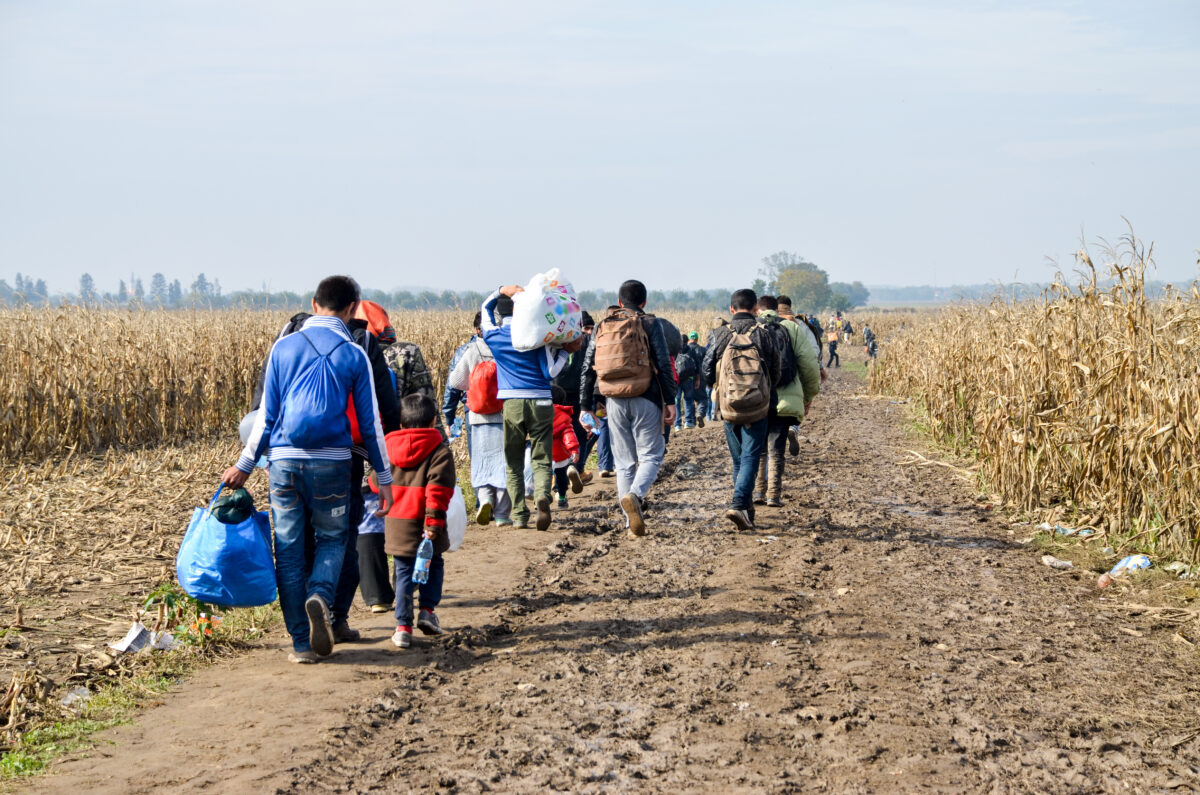
group-of-war-refugees-walking-in-cornfield-syrian-refugees-c-379881175-stockpack-adobestock
Group of War Refugees walking in cornfield. Syrian refugees crossing border to reach EU. Iraqi and Afghans. Balkans Route. Migrants on their way to European Union. Large group of people immigrate
Image Credit: Ajdin Kamber - Adobe Stock

Medical Journal Supports Unlimited Migration

The Lancet just published an editorial that essentially supports unlimited migration — although it doesn’t use that term — and makes no distinction between legal and illegal immigration. From, “Migration a Reality, Not an Emergency:” Migration is among the oldest facts of human life, yet it is treated as one of the newest emergencies: anti-immigration protests have intensified in the UK and immigration raids have swept US cities. As we mark World Refugee Day, the follow-up Review to the 2018 UCL-Lancet Commission on Migration and Health, published in this issue, renews the Commission’s call for action and asks whether, in a climate shaped by fear, evidence can still drive policy. The editorial ignores international and national laws. In the United Read More ›

chinese-flags-on-barbed-wire-wall-in-kashgar-kashi-xinjiang-279388155-stockpack-adobestock
Chinese flags on barbed wire wall in Kashgar (Kashi), Xinjiang, China.
Image Credit: Jonathan Densford - Adobe Stock

Article in The Lancet Decries Bioethics Conference for Not Condemning Genocide

An article in The Lancet decries the recent 17th World Conference on Bioethics, Medical Ethics, and Health Law for failing to condemn “genocide.” Of course, the authors are referencing Israel’s self-defense in Gaza. From, “Silence on Genocide at the World Conference on Bioethics:” Between Nov 24 and Nov 27, 2025, the International Chair in Bioethics held its 17th World Conference on Bioethics, Medical Ethics, and Health Law in Ljubljana, Slovenia. Despite being hosted in a nation whose President has vocally condemned the “genocide in Gaza” at the UN, the conference stood in stark contrast to its setting. No scheduled sessions discussed the ongoing humanitarian catastrophe, representing a profound disconnect between the event’s location and its content… If an organisation claiming Read More ›

border-patrol-officers-patrol-along-corrugated-metal-wall-se-1129781636-stockpack-adobestock
Border patrol officers patrol along corrugated metal wall. Security personnel walk along desert path. Wearing camouflage uniforms, body armor. Scene likely at border region. Photo of security
Image Credit: Vadym - Adobe Stock

Medical Journal Articles Decry Immigration Enforcement

The usual suspect medical and science journals have featured far fewer columns promoting progressive politics of late. Alas, it couldn’t last forever. The New England Journal of Medicine just published two opinion articles decrying immigration enforcement as inimical to public health.

The first column focuses generally on the adversity the author believes is caused to illegal immigrant communities by enforcing the law:

Current immigration enforcement is disrupting medical follow-up, exacerbating mental health symptoms, causing more patients to skip preventive care, and deepening mistrust in public institutions. In my clinical practice, I have seen sharp increases in anxiety, school absenteeism, deferred visits, and acute psychiatric symptoms after enforcement events. These effects are both predictable and preventable. Clinicians, health systems, and policymakers should recognize immigration enforcement as a social determinant of health currently implicated in a public health crisis and act accordingly. [Citations omitted.]

In other words, don’t enforce the law.

Read More ›