Humanize From Discovery Institute's Center on Human Exceptionalism
Category

Health Care

medical-ventilator-showing-vital-signs-in-hospital-room-stoc-1345794264-stockpack-adobestock
Medical ventilator showing vital signs in hospital room
Image Credit: Archibalttttt - Adobe Stock

U.K. Hospital Unilaterally Cuts Off Life Support of Disabled Patient over Family Objections

Readers may recall the Charlie Gard and Alfie Evans cases in the U.K., in which National Health Service hospitals took the parents of terminally ill children to court after they refused to acquiesce in doctors’ recommendations that life support be ended.

In both cases, the court ruled in the hospital’s favor in determining both that life support could be ended and preventing the parents from transferring care of their children to medical facilities willing to provide last-ditch treatments that the families wanted.

Now, a Trust hospital hasn’t even bothered going to court. Instead, doctors have unilaterally withdrawn kidney dialysis over family objections from Robert Barnor, who was profoundly disabled by a stroke, stating that letting the man die is merely a “clinical” decision. From the Telegraph story:

The 68-year-old suffered extensive brain damage and can now only open his eyes and move his head. He requires twice-weekly dialysis treatment for kidney disease, without which he would be expected to die within days.

On Wednesday, the hospital told his family it had made a “clinical decision” to end Mr Barnor’s dialysis and provide palliative care until he dies.

Read More ›
Episode 16 thumbnails

Vaccines, Trust, and Informed Consent After COVID with Dr. Jay Richards

In a post-COVID world, families are asking harder questions about vaccines and those questions deserve serious, ethical answers. In this episode of Bioethics Babe, I’m joined by Jay Richards, Vice President of Social and Domestic Policy and the William E. Simon Senior Research Fellow in American Principles and Public Policy at The Heritage Foundation, where he also chairs the Restoring American Wellness initiative. He is also a senior fellow at Discovery Institute. We explore how families can think clearly and ethically about vaccines after COVID. This conversation covers informed consent, risk-benefit analysis, parental responsibility, the updated CDC childhood immunization schedule, and the growing crisis of trust in public health institutions. This episode is for parents, healthcare professionals, policymakers, and anyone Read More ›

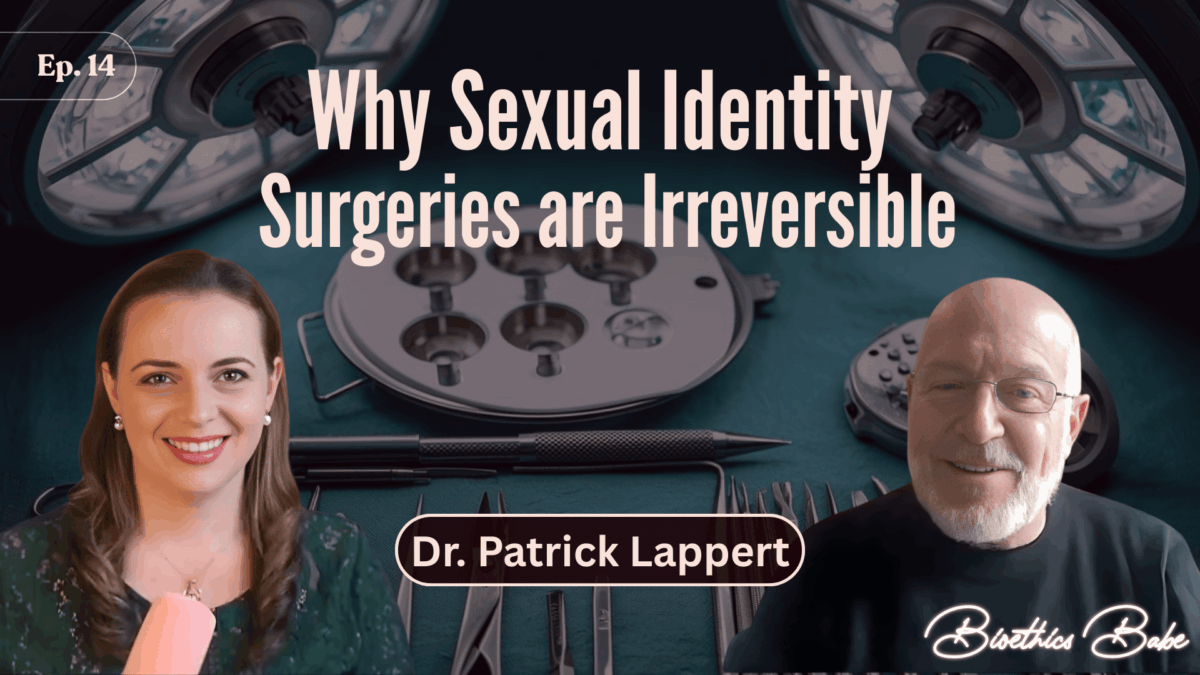
_Episode 14 thumbnail

A Surgeon Speaks Out: Why Surgical Intervention for Sexual Identity Disorder Are Irreversible and Unethical with Dr. Patrick Lappert

What do surgical interventions on people with sexual identity disorder actually do to the human body and are any of them reversible? In this episode of Bioethics Babe, host Arina Grossu Agnew sits down with Dr. Patrick Lappert, a twice board-certified plastic and reconstructive surgeon, former U.S. Navy Captain, and former Chief of Plastic and Reconstructive Surgery at Portsmouth Naval Hospital. Dr. Lappert spent more than 30 years in the operating room, including decades rebuilding bodies damaged by trauma, cancer, congenital deformities, and combat injuries. In this conversation, he explains in precise medical detail why surgical interventions on people with sexual identity disorder are cosmetic, irreversible, and ethically incompatible with basic principles of surgery, especially when performed on minors. In Read More ›

medical-research-scientist-examines-laboratory-mice-and-look-166977106-stockpack-adobestock
Medical Research Scientist Examines Laboratory Mice and Looks on Tissue Samples under Microscope. She Works in a Light Laboratory.
Image Credit: Gorodenkoff - Adobe Stock

For MAHA’s Sake Don’t Eliminate Animal Research

Secretary of Health and Human Services Robert F. Kennedy Jr. made big news recently when he declared that he wanted to eliminate federal funding for research on primates and eventually end all government support for animal experimentation. RFK Jr. says he’ll work with federal agencies to wind down animal testing. One can certainly understand his reasons. Animal suffering makes anyone with a conscience flinch in empathetic revulsion.

But scientists do not engage these methodologies out of sadistic purpose. Rather, their goals are to find new medical treatments, cure diseases, and generally reduce human (and animal) suffering. Indeed, without animal research, the many medical and veterinary advances achieved since World War II would have been impossible. That is why we must think about this important moral issue and not just “feel.”

Most animal work involves basic research—investigations about how bodily systems function. Here’s the story of just one such use that resulted in tremendous reduction in human suffering.

Years ago, Dr. Edward Taub hypothesized that brain function could exhibit greater plasticity than then believed. To determine whether he was right, the nerves in monkeys’ forelimbs were severed surgically. Taub’s purpose was to train the animals to reuse their numb forelimbs; research he hoped would prove valuable in ultimately rehabilitating human stroke patients.

Read More ›
medical-professional-carrying-a-cooler-for-organ-transport-s-1068378728-stockpack-adobestock
Medical professional carrying a cooler for organ transport, symbolizing organ preservation and transplantation logistics.
Image Credit: TensorSpark - Adobe Stock

Will Assisted Suicide Coupled with Organ Harvesting Come to the U.S.?

Once someone is considered killable or supported in suicide, they may become objectified so as to be used instrumentally. Such is the case with people requesting to be euthanized. The idea is that they are going to die anyway, want to die — even as they do not receive suicide prevention — so we might as well get good use out of them such as by conjoining their hastened deaths with organ harvesting. This abandonment (in my view) is rife in Canada, where in Ontario, a patient approved for a lethal jab will soon receive a call from the organ procurement society asking for their organs. The Netherlands and Belgium also permit conjoining organ harvesting — including of mentally ill Read More ›

doctors-in-a-busy-hospital-staff-room-arguing-over-a-treatme-1687034712-stockpack-adobestock
Doctors in a busy hospital staff room arguing over a treatment plan hands gesturing passionately as charts and notes cover the table fluorescent lighting amplifying urgency atmo
Image Credit: Kateryna - Adobe Stock

My Criticism of Lawrence Masek’s Bioethics Article Stands

I welcome Lawrence Masek’s response to my criticism of his journal article. I am sorry he didn’t appreciate my perspective, but I take nothing back.

Let’s start with a matter of little importance. Masek claimed I said his article would curl your toes. No, I wrote that I cover articles published in the professional journals because “some” of them would. Whether your digits react to his effort thusly is a matter for you to decide.

As to the substance of his rebuttal, Masek claims at great length that the dead donor rule, which forbids killing for organs, would also prohibit many common interventions in clinical medicine as “suicide.” He writes:

Permitting lethal organ procurement would enable patients to commit suicide by donating their vital organs, but the same is true of permitting lethal palliation and the refusal of life support.

This is verifiably untrue. Dying from a side effect of an ethical medical treatment like palliation is not suicide any more than a patient dying during heart surgery is euthanasia.

Read More ›
team-of-surgeons-operating-stockpack-adobe-stock-150608240-stockpack-adobestock
Team of Surgeons Operating.
Image Credit: santypan - Adobe Stock

Bioethicist: Let Surgeons Kill Patients During Organ Harvesting

The “dead donor rule” (DDR) is a legal and ethical mandate that requires vital organ donors to be truly dead before their body parts are procured. A corollary to the rule holds that people cannot be killed for their organs. The DDR promotes trust in the system and protects the vulnerable — but is flexible enough to permit living donations of one kidney and parts of a liver from altruistic donors. Utilitarian bioethicists have long argued against the DDR and its corollary based on the notion that killing those who are dying or want to donate will relieve the suffering of people who want to live and need an organ. And here we go again. The Journal of Medical Ethics Read More ›

Episode 11 Thumbnail - YouTube

Puberty Blockers, Cross-Sex Hormones, and the Dark Origins of Gender Ideology with Pediatric Endocrinologist Dr. Quentin Van Meter

In this episode, pediatric endocrinologist Dr. Quentin Van Meter reveals the truth behind one of the most controversial practices in modern medicine: the use of puberty blockers and cross-sex hormones on children with sexual identity confusion. He also outlines the disturbing legacy of John Money, the man whose unethical experiments helped launch today’s gender ideology. With over four decades of clinical experience, including training at Johns Hopkins and service in the U.S. Navy, Dr. Van Meter explains how chemical and surgical interventions on children with sexual identity disorder swept through pediatrics despite a lack of scientific evidence, how clinics rapidly adopted irreversible interventions, and why so many doctors feel pressured to “affirm” rather than question. Dr. Van Meter shares: He Read More ›

transgender-care-stethoscope-on-lgbt-flag-background-healthc-1661502234-stockpack-adobestock
Transgender Care: Stethoscope on LGBT Flag Background - Healthcare and Business Concept
Image Credit: Mykola - Adobe Stock

Bioethics Journal: AI-Generated “Digital Twins” for Trans Patients?

In an article in the Journal of Medical Ethics — one of the field’s most influential publications — an independent researcher argues that transgender people should be granted access to AI-generated “digital twins” to allow them to “design” themselves before undergoing transition interventions. From “Designing Inclusive Digital Twins: Ethical and Practical Considerations for Trans Healthcare”: DTs combine AI, big data analytics and sensor technology to create dynamic, patient-specific models that enhance diagnosis, prognosis and treatment planning. For trans individuals, DTs could transform gender-affirming care by offering precise simulations of HRT effects, such as changes in body composition or emotional well-being, or visualising surgical outcomes tailored to individual goals. This means a lot of reprogramming of AI software: Current datasets often Read More ›

asian-physician-nurse-support-to-elderly-male-patient-on-whe-503857157-stockpack-adobestock
Asian physician nurse support to elderly male patient on wheelchair.
Image Credit: Kawee - Adobe Stock

Should Caregivers Be Forced to Starve Dementia Patients to Death?

There is a move afoot among bioethicists to allow written directives by dementia patients, signed before the patients have become incompetent, to force caregivers to withhold spoon-feeding and liquids from those patients. Now, one of the country’s most notable and oft-quoted bioethicists, Arthur Caplan, has taken a position in favor of such a policy, in an article in the online publication Medscape.

First, Caplan discusses the potential withholding of feeding tubes (artificial hydration and nutrition, or AHN, in medical parlance), which is unquestionably legal because AHN is a medical treatment that involves surgery and medically prepared nutrients and — like other treatments, ranging from surgery to chemotherapy — can be ordered through advance directives to be withheld or withdrawn. Right or wrong, that’s a done deal. (He brings up the Terri Schiavo case, about which he and I significantly disagree, but let’s not relitigate that here.)

Then, however, Caplan takes the next step — which is currently on the cutting edge of bioethical discourse. From “Artificial Hydration and Nutrition in Dementia: Ethicist Weighs In”:

Is feeding by spoon the same as medical intervention with artificial forms of hydration and nutrition? I believe it is. I believe that when you say “no more food and nutrition,” it isn’t just the equipment. I’ll put it simply: It’s who’s on the end of the spoon. If nurses or doctors are feeding, it’s medical. It’s professional care, and you should be able to say no to that.

Read More ›