Humanize From Discovery Institute's Center on Human Exceptionalism
Category

Hospice

woman-holds-the-hands-of-a-senior-citizen-in-the-hospice-277304446-stockpack-adobestock
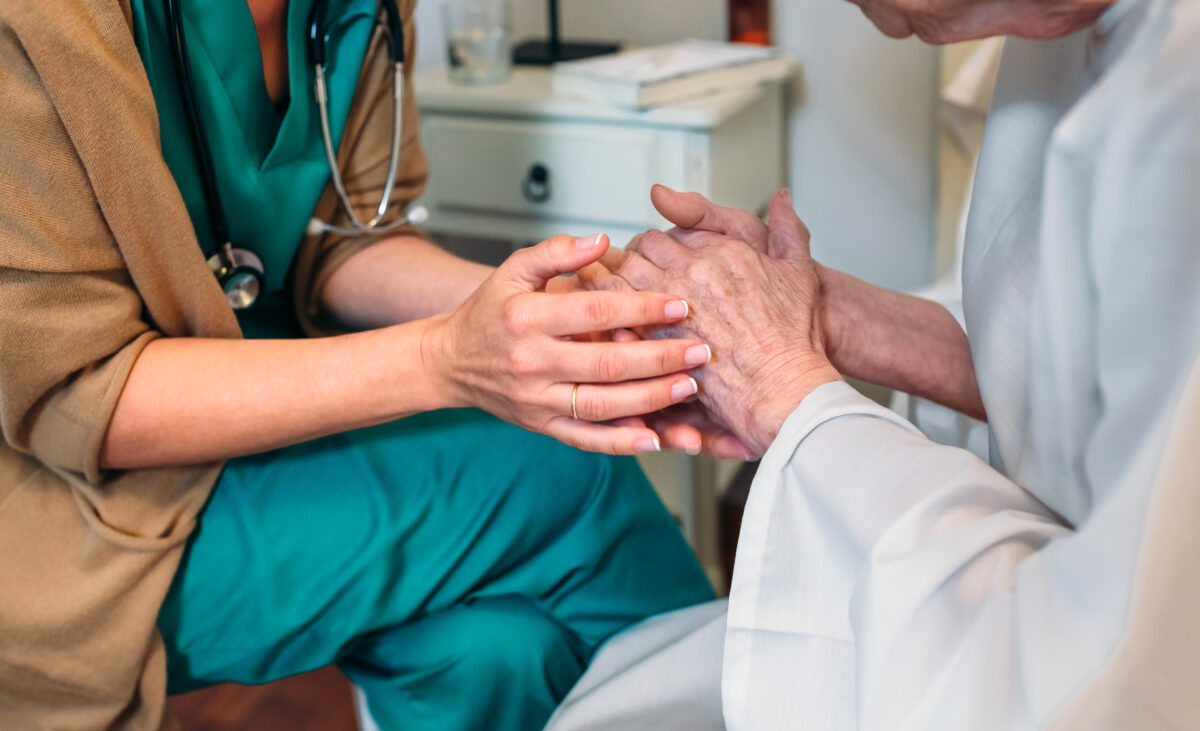
Woman holds the hands of a senior citizen in the hospice
Image Credit: Robert Kneschke - Adobe Stock

Should Suicide by Self-Starvation Be Grounds for Hospice Care?

The other day, in response to the British Medical Association requiring doctors to participate in VSED (voluntary stop eating and drinking) suicides, I wrote that “suicide nihilism is exerting an ever-increasing gravitational force.” With this post, I double down on that depressing conclusion.

Hospice was designed to care for people who are diagnosed with terminal illnesses until their natural deaths. But a study just published in the Journal of Pain and Symptom Management — the publication of the American Academy of Hospice and Palliative Medicine — argues that people intending to commit suicide via VSED should qualify for hospice care even if they are not otherwise dying!

What? Why? Because someone dying within six months qualifies for hospice. VSED takes less than that amount of time to die. Hence, such suicidal people should be admitted to hospice. The mind just boggles.

Read More ›


back-view-of-lonely-young-asian-woman-sitting-on-bed-in-hosp-336558111-stockpack-adobestock
back view of lonely young asian woman sitting on bed in hospital ward. depressed female patient stay in room with body check result paper beside. sad lady in pajamas looking out window indoor
Image Credit: PR Image Factory - Adobe Stock

British Medical Association Requires Doctors to Help Patients Commit Suicide by Self-Starvation

The subtitle of the revised and updated version of my book criticizing utilitarian bioethics, Culture of Death, is, “The Age of ‘Do Harm’ Medicine.” Helping patients kill themselves by self-starvation and dehydration — known in euthanasia parlance as VSED (for voluntary stopping eating and drinking) — certainly fits that designation.

Two major medical associations now have endorsed doctors assisting in such suicides by palliating the painful symptoms to help patients go all the way to death. The first was the American Academy of Hospice and Palliative Medicine (AAHPM) in 2023. This is especially notable because the organization shamefully went “neutral” on the legalization of assisted suicide, despite that action being the antithesis of the hospice philosophy enunciated by the great medical humanitarian Dame Cecily Saunders. The AAHPM’s journal also published a piece recently endorsing intentionally undernourishing dementia patients under certain conditions (MCF, or “minimal comfort feeding”) — VSED in slow motion, if you will.

Now, another “do harm” shoe has dropped. The British Medical Association has issued an ethical guidance that requires practitioners to participate in VSED when asked to do so by a patient. While the AAHPM guidance assumes that the act will only be done by terminally ill or seriously ill or disabled patients, the BMA guidance notably acknowledges that even those not in ill health can kill themselves in this slow manner — and that doctors must further the suicide palliatively. From the guidance (my emphasis):

Read More ›
senior-woman-holding-quad-cane-handle-in-elderly-care-facili-479530272-stockpack-adobestock
Senior woman holding quad cane handle in elderly care facility. Hospital nurse taking care of mature female with walking stick in nursing home. Background, close up on hands with wrinkled skin.
Image Credit: Evrymmnt - Adobe Stock

What’s Happened to Hospice?

Discovery Institute Senior Fellow and Chair of the Center for Human Exceptionalism Wesley J. Smith was quoted in the following article, “What’s Happened to Hospice?”, originally published at National Catholic Register. The following is an excerpt. We encourage readers to go to National Catholic Register to read the full piece.


Many Catholic families can testify to the positive experiences they’ve had with hospice programs that cared for loved ones in their final days with dignity and compassion.

But recent news reports about rampant fraud have cast hospice in a different light. In June, for example, federal authorities charged the operator of multiple Los Angeles hospice businesses, along with a group of alleged accomplices, with a $27-million fraud scheme that involved stealing the identities of dead people and billing the government for phony healthcare services, using the proceeds to pay for luxury items including lease payments on a Rolls-Royce Phantom sedan that costs more than $500,000.

“Can you imagine anything more low than to pretend you’re taking care of dying people when you’re not?” said Wesley J. Smith, chair and senior fellow at the Center on Human Exceptionalism, a bioethics and public policy program of the Seattle-based Discovery Institute that focuses on issues of human dignity, liberty and equality.

Hospice leaders and other experts say the flood of such hospice scandals is symptomatic of a profit-driven mindset that has taken hold in what is now a $31-billion-a-year industry, moving hospice farther and farther away from its roots as a Christian work of mercy predicated on the fundamental dignity of human life.

“I’m a big supporter of good hospice care,” Smith said. “But I’m worried about the direction hospice is going.”

Read More ›
female-doctor-giving-encouragement-to-elderly-patient-by-hol-185990670-stockpack-adobestock
Female doctor giving encouragement to elderly patient by holding her hands
Image Credit: David Pereiras - Adobe Stock

We Need to Save the Hospice Movement

The modern hospice movement is one of the great humanitarian advances of the last hundred years. The story began shortly after World War II, when a young, devout Anglican medical social worker named Cicely Saunders befriended a Jewish émigré named David Tasma. Tasma had escaped the Warsaw Ghetto only to be dying at age 40 in a London hospital. He was alone in the world, and Saunders made a special point to visit with him every day. Their friendship changed how we medically treat—and perhaps even more importantly, perceive—people who are dying. I was honored to interview Dame Cicely (as she is affectionately known in the United Kingdom) in 1998 while researching my book Culture of Death. In reflecting on her Read More ›