Humanize From Discovery Institute's Center on Human Exceptionalism
Category

Scientism

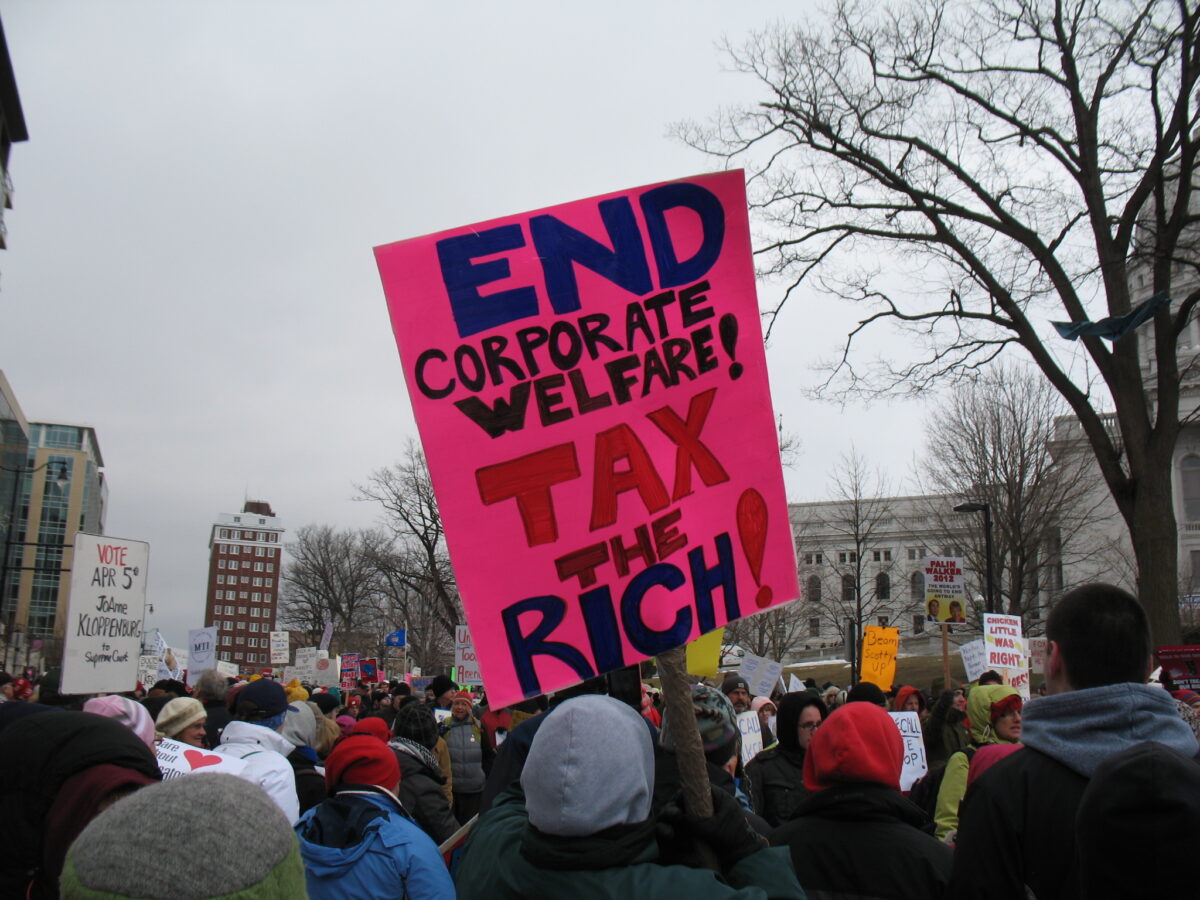
ProtestTaxtheRich5521705234
Image from Wikimedia Commons: https://commons.wikimedia.org/wiki/File:Protest_Tax_the_Rich!_(5521705234).jpg

Should Scientists Decide Policies About Wealth Inequality?

The other week, I discussed a Nature editorial advocating that scientists be required to “register” with the state. That policy, if enacted, would be a step toward establishing a technocratic rule-by-experts system by controlling what would be acceptable scientific discourse and who would be authorized to communicate about such matters. A new proposal, also in Nature, would push the West toward technocracy. The science journal just published a piece urging the U.N. to establish a panel of scientists — the International Panel on Inequality (IPI) — to determine policies involving income and wealth inequality. From “Why We Need an International Panel on Inequality:” The consequences [of wealth disparities] are well established. A growing body of research links higher income inequality Read More ›
Wesley-J-Smith-Issues-Etc

Wesley J. Smith Talks with Todd Wilkens About Attempts to Regulate Science

Wesley J. Smith spoke with Todd Wilkens on the Issues, Etc. radio program on September 8, 2026, to discuss the latest proposal in Nature to require scientists to register with the government. Smith spoke about the danger this poses to free inquiry and the scientific method. “But what you see instead now too often in science is a suppression of different opinions because many in science have confused scientific policy and ideology with the scientific method,” Smith explained. “So some in science have moved from science to scientism where it becomes a form of belief as opposed to a method.” Smith and Wilkens also discuss recent developments in assisted suicide, including the money being made from it and the way Read More ›

Stand_Up_For_Science_in_Seattle_2025
Image by LivingBetterThroughChemistry at Wikimedia Commons: https://upload.wikimedia.org/wikipedia/commons/7/75/Stand_Up_For_Science_in_Seattle_2025.jpg

Stand Up for (Ideological) Science 2025 Day!

Yesterday was “Stand Up for Science 2025” day, which featured rallies around the country to “defend science as a public good and pillar of social, political, and economic progress.” But that isn’t what it was really all about. From the “Stand Up for Science” website’s listed policy goals: 1. End Censorship and Political Interference in Science Science thrives on open inquiry and evidence-based decision-making. We demand: An end to government censorship: Prohibit all forms of political censorship in scientific research, including restrictions on the topics of scientific research that are eligible for federal funding… A commitment to freedom of scientific expression: Protect scientists’ rights to communicate their findings freely, without fear of retaliation or suppression. Well, that’s ironically rich. Former NIH head Francis Collins spoke (and sang) at Read More ›

in-a-modern-industrial-facility-scientists-and-technicians-w-657235995-stockpack-adobe_stock
In a modern industrial facility, scientists and technicians work together on pharmaceutical and medical research
Image Credit: Andrii Zastrozhnov - Adobe Stock

Science Blogger: It Should Be a Crime to Violate the “Scientific Consensus”

The push to impose rule by “scientific consensus” continues apace — even as the American people clearly rejected that view in the last election (thanks in no small part to how the public health consensus blew the Covid response). But the science powers that be refuse to learn. In fact, they appear to be doubling down. Now, Ethan Siegel, an astrophysicist and award-winning science writer, advocates for criminally and civilly punishing violators of the “scientific consensus.”

First, Siegel defines what he means by “scientific consensus.” From, “4 Key Steps to Transform the USA Back into a Scientific Nation:”

Only in the presence of decisive evidence can consensus be achieved. Consensus is not “the end goal” of science, but rather a starting point for future advances: the foundation of what is not just known, but is widely accepted for good reason, at present. Consensus is, to be blunt, what the overwhelming majority of professionals have concluded is already strongly established by the existing evidence so far.

But conformity of belief does not make it right. The supposed scientific consensus can be more ideology than science. Take eugenics. For decades in the early 20th century, the scientific consensus supported dividing human beings into the “fit” and “unfit.” That consensus became so motivating that many states passed laws requiring involuntary sterilizations, a pernicious policy supported by an 8-1 decision in the Supreme Court, with Buck v Bell (1927) becoming one of history’s great injustices.

Read More ›
Donald_Trump_(43627678700)
Image by Gage Skidmore at Wikimedia Commons: https://commons.wikimedia.org/wiki/File:Donald_Trump_(43627678700).jpg

Post-Election, “Nature” Publishes Yet Another Anti-Trump Screed

Sometimes the most intelligent people are the least smart. That sure seems true of the editors of Nature, once the universally respected British science journal. As I have noted before, Nature is becoming almost as ideological as it is scientific. It endorsed Kamala Harris for president and then, just before the election, doubled down on excoriating Donald Trump for somehow being anti-science — when most of the issues discussed in the article were blatantly political. Now that Trump is president-elect after an overwhelming electoral victory — and an apparent popular-vote victory — one would think that Nature’s editors would have the common sense to cease from excoriating him. But no. It just published another anti-Trump screed declaring that the world’s scientists are aghast that he won the election. Read More ›

Donald_Trump_(32758233090)
Image by Gage Skidmore at Wikimedia Commons: https://commons.wikimedia.org/wiki/File:Donald_Trump_(32758233090).jpg

“Nature” Editorial Attacks Trump Because He Ignored “Scientific Consensus”

The idea that "science" and the supposed "scientific consensus" — which too often is really political consensus within the science establishment — are synonymous is causing tremendous harm to the scientific sector. But the science establishment keeps forging widespread public distrust by doubling down on the politics. Read More ›
Illinois_Handmaids_Stop_Brett_Kavanaugh_Rally_Downtown_Chicago_Illinois_8-26-18_3437_(42505508810)
Image by Charles Edward Miller at Wikimedia Commons: https://commons.wikimedia.org/wiki/File:Illinois_Handmaids_Stop_Brett_Kavanaugh_Rally_Downtown_Chicago_Illinois_8-26-18_3437_(42505508810).jpg

Medical Journal Trots Out Trite “The Handmaid’s Tale” Metaphor to Oppose Natalism

Cratering birth rates are threatening a “demographic winter,” according to a recent Wall Street Journal story, causing government leaders to believe that increasing the number of babies born has become “a matter of national urgency.” But the ever woke New England Journal of Medicine is having none of it. Instead, it published a bitter piece castigating “pro-natalism” that even deploys the ridiculous The Handmaid’s Tale cliché to make its points. From “Blessed be the Fruit” (citations omitted): “Pronatalism” is an attitude or policy approach that encourages childbearing and elevates the role of parenthood, specifically for women, as a necessary and positive societal contribution, often deliberately at the expense of women’s opportunities in education, governance, and the workforce. . . . Regardless of the stated motivations, such Read More ›