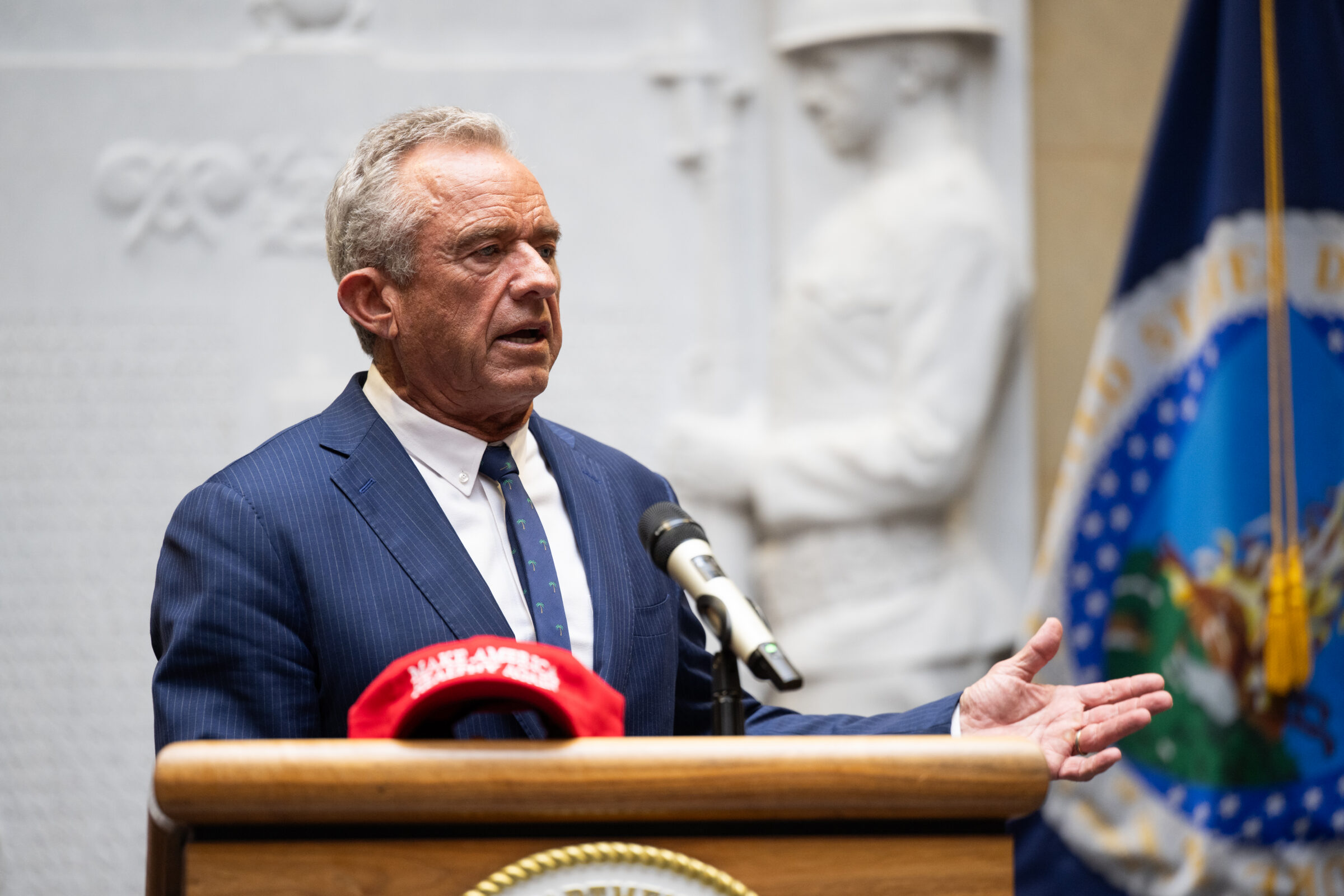
SecretaryBrookeRollinsannouncestheUSDAscommencement
U.S. Secretary of Health and Human Services Robert F. Kennedy Jr delivered some remarks during the announcement of USDA’s commencement of the Dietary Guidelines for Americans Strategic Partnerships and an update on the impending Stocking Standards final rule, a rule that holds any retailer interested in accepting Supplemental Nutrition Assistance Program (SNAP) benefits accountable to a higher minimum standard of staple food stocking requirements. Additionally, Secretary Rollins will sign additional SNAP food restriction waivers, USDA Headquarters, Washington D.C., March 4, 2026. (USDA photo by Christophe Paul)
USDA Image at Wikimedia Commons: https://commons.wikimedia.org/wiki/File:Secretary_Brooke_Rollins_announces_the_USDA%E2%80%99s_commencement_of_the_Dietary_Guidelines_for_Americans_Strategic_Partnerships_alongside_HHS_Secretary_Kennedy_and_Dr_Ben_Carson_(20260304-USDA-OSEC-CDP-1583).jpg
Humanize From Discovery Institute's Center on Human Exceptionalism
Share
Facebook
Twitter/X
LinkedIn
Flipboard
Print
Email

RFK Criticized for Disrespecting Roadkill

Originally published at National Review
Categories
Animal Welfare
Bioethics

These days, it seems that everything is about bioethics. Case in point: A zoologist named Sam Zeveloff has criticized RFK Jr. in Stat News for disrespecting a dead raccoon back in 2001 by allegedly dissecting its penis. This act, the emeritus professor claims, raises "critical questions" that must be addressed.

Oh my. One wonders about the possible moral stakes of this historical cadaveric mutilation.

Such phallus-collecting, we are told by Zeveloff, is fine so long as it's done for a valid scientific or educational purpose. In fact, the author brags that he has collected raccoon phalluses himself, some of which are displayed at the Icelandic Phallological Museum. Okaaay.

But Kennedy's cadaveric collecting wasn't, from a bioethical standpoint, properly "scientific":

If Kennedy collected a racoon specimen without a defined scientific or educational purpose, the ethical justification becomes less clear. Indeed, the public has no idea about why he would stop a car filled with his family members and cut out a raccoon's penis from a carcass.

Continue Reading at National Review

Wesley J. Smith

Chair and Senior Fellow, Center on Human Exceptionalism
Wesley J. Smith is Chair and Senior Fellow at Discovery Institute’s Center on Human Exceptionalism. Wesley is a contributor to National Review and is the author of 14 books, in recent years focusing on human dignity, liberty, and equality. Wesley has been recognized as one of America’s premier public intellectuals on bioethics by National Journal and has been honored by the Human Life Foundation as a “Great Defender of Life” for his work against suicide and euthanasia. Wesley’s most recent book is Culture of Death: The Age of “Do Harm” Medicine, a warning about the dangers to patients of the modern bioethics movement.