Humanize From Discovery Institute's Center on Human Exceptionalism
Topic

in vitro fertilization

YouTube Thumbnails, under 2 MB (5)

Designer Babies: When IVF Becomes Human Design with Dr. Tara Sander Lee

IVF was introduced as a way to address infertility, even though it is fraught with ethical problems. But today, it increasingly involves grading embryos, screening genetic traits, and deciding which embryos are chosen. Are we entering an era where reproduction becomes human design? In this episode, Harvard-trained biochemist Tara Sander Lee, Ph.D., explains how modern IVF increasingly involves eugenic practices. We examine: As IVF expands beyond infertility “treatment” and into optimization, urgent questions emerge about human dignity, disability, and the moral limits of reproductive technology. This is a conversation about science, power, and whether medicine is meant to heal people or to redesign them. For Episode Resources, please visit the episode page here. For more information, the latest episodes, and Read More ›


YouTube Thumbnails, under 2 MB (2)

Is Love All You Need? Truth, Intention, and Moral Action with Fr. James Brent, OP

Is love really all you need to make something ethical? In a culture that treats good intentions as the highest moral standard, this episode asks a harder and more important question: Can love be ethical without truth? In this episode of Bioethics Babe, I’m joined by Fr. James Dominic Brent, OP, a Dominican priest and philosopher in the Thomistic tradition, to examine why sincerity alone isn’t enough in moral decision-making, especially in medicine, relationships, and family life. Drawing on Catholic moral theology and the philosophy of St. Thomas Aquinas, Fr. Brent explains: From IVF to euthanasia to sexual ethics, consent, and modern ideas of affirmation, this conversation challenges the assumption that “if it’s done out of love, it can’t be Read More ›

frustrated-young-woman-is-suffering-after-miscarriage-she-is-205790747-stockpack-adobestock
Frustrated young woman is suffering after miscarriage. She is looking at ultrasound pictures of her unborn baby and crying. Man is sitting and embracing her with love. Copy space
Image Credit: Yakobchuk Olena - Adobe Stock

An Ethical Alternative to IVF

Approximately 10-15% of U.S. couples of reproductive age experience infertility. One response is to pursue in vitro fertilization (IVF), which is fraught with many negative ethical and practical implications. Another way is to get to the root cause of infertility. Shouldn’t that be the MAHA way? President Trump expanded access to IVF with his February 2025 executive order. In October, he lowered costs for IVF and other fertility treatments. While IVF does indeed “create” more babies, it comes at a steep physical, emotional, and ethical cost for couples (for an in-depth discussion of these and other issues relating to IVF, please see my podcast episode with Emma Waters on Bioethics Babe). At its heart, IVF circumvents infertility by moving procreation Read More ›

Episode 8 Thumbnail

Inside the IVF Industry: The Hidden Costs of Creating Humans in a Lab and the Restorative Alternative with Emma Waters

In this powerful episode of Bioethics Babe, Emma Waters, a policy analyst at the Heritage Foundation’s Center for Technology and the Human Person, joins Arina Grossu Agnew to unpack the hidden costs of in-vitro fertilization (IVF) and the ethical questions surrounding the fertility industry. While IVF is often hailed as a miracle solution for infertility, few people stop to ask what’s lost when life begins in a lab instead of the womb. Emma explains why IVF bypasses the real causes of infertility, the moral and physical risks it poses, and how Restorative Reproductive Medicine (RRM) offers a healthier, more human-centered alternative that heals the body rather than replacing it. We discuss: If you’ve ever wondered what IVF means for medicine, Read More ›

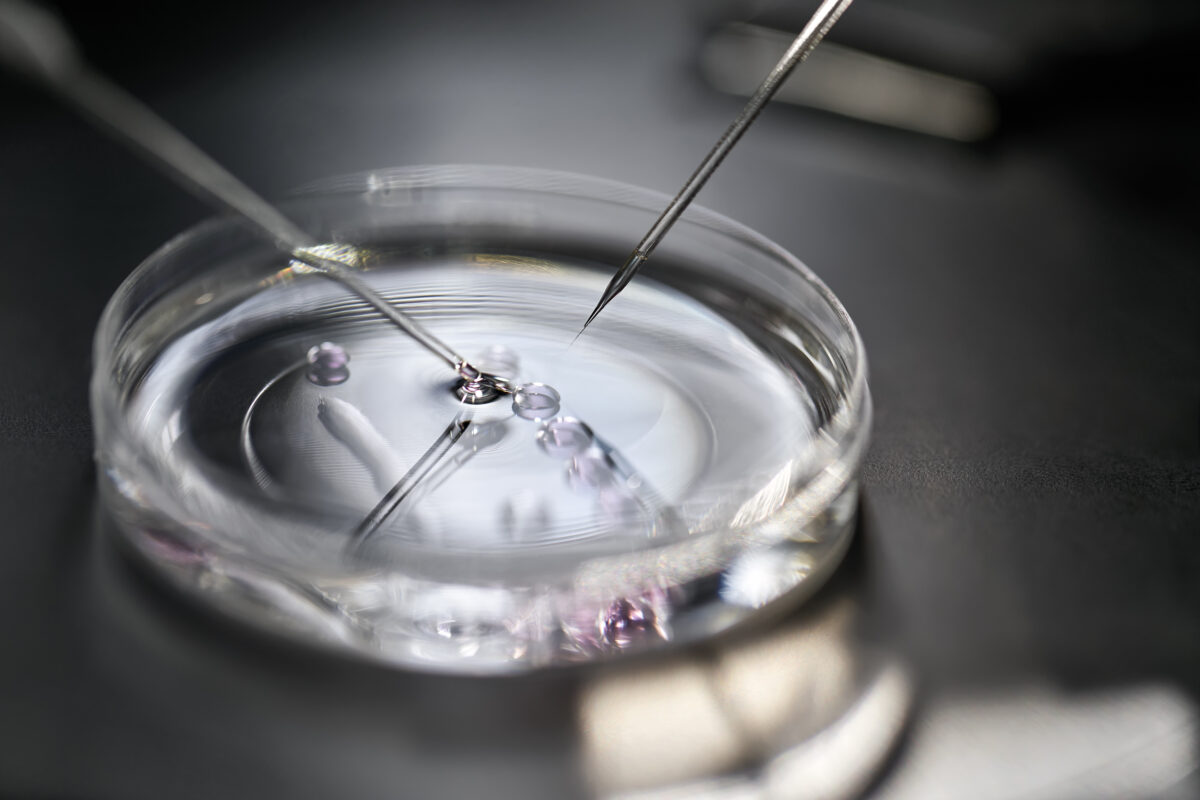
close-up-of-reproductive-specialist-studying-embryos-under-m-611063585-stockpack-adobestock
Close up of reproductive specialist studying embryos under microscope
Image Credit: Viacheslav Yakobchuk - Adobe Stock

Radical Reproduction Turns Children Into Products

Should men have the right to have their cells manipulated so they can become biological mothers? Should women past child-bearing age have the same right if their own eggs are no longer viable? More to the point, should we all have the right to do whatever it takes to have a baby if that is our desire and also, to obtain the baby we want?

These questions have ceased to be grist for science fiction authors. Researchers recently announced that they have genetically manipulated human skin cells to become eggs, including those of men (the idea being to eventually enable both members of a same sex couple to have a genetic connection with their child). Then, after more genetic tinkering, the eggs were fertilized into embryos via IVF. Finally, the biotechnologists monitored embryonic development until the experiment was stopped, and the embryos destroyed.

No pregnancy has been established with this technique. But that is cold comfort. The researchers plan to keep experimenting and I have little doubt that when they overcome remaining technical difficulties, someone will create a pregnancy using “skin cell” embryos. After all, what beyond self-restraint—currently in little supply in this field—is to stop them?

Read More ›
process-of-in-vitro-fertilization
Image Credit: Andriy Bezuglov - Adobe Stock

IVF Isn’t the Pro-Life Option for Addressing Fertility Issues

A bill proposed by Sen. Tammy Duckworth, D-Ill., is far too extreme since it contains a sweeping definition of "assisted reproductive technology," which goes beyond the deregulation of the IVF industry, and would legalize human cloning, surrogacy, gene editing, human-animal chimera hybrids, and other abuses of human embryos. Read More ›