Humanize From Discovery Institute's Center on Human Exceptionalism
Topic

infertility

YouTube Episode Thumbnails under 2 MB (20)

Seven Miscarriages, Two Living Children, and the Hidden Grief So Few Talk About with Gabriela Anastasopoúlou

Seven miscarriages. Two living children. Countless questions. What does it actually feel like to lose a child through miscarriage? What happens when the pregnancy test line starts fading and you realize you’re about to lose another baby? Why do so many women feel completely unprepared for the physical, emotional, and spiritual reality of miscarriage, despite the fact that roughly 1 in 4 pregnancies ends in miscarriage? In this deeply personal and moving conversation, Gabriela Anastasopoúlou shares her journey through a miscarriage, becoming a mom to her son, followed by seven miscarriages and secondary infertility, and the eventual birth of her daughter after years of unanswered questions and heartbreak. Gabriela opens up about: As a civil rights attorney and advocate for Read More ›

a-female-patient-has-a-consultation-with-her-gynecologist-in-678198655-stockpack-adobestock
A female patient has a consultation with her gynecologist in a medical clinic. Women's health, colposcopy, examination of the uterus and ovaries.
Image Credit: wedmoments.stock - Adobe Stock

Uterine Transplants and Reproductive Anarchy

Uterine transplants are becoming more common to enable infertile women — and perhaps, eventually men — to give birth. How’s that project going? A new study detailing the outcomes of more than 40 cases of uterine transplants and subsequent IVF-enabled pregnancies published in JAMA provides details: Between 2016 and March 2026, a total of 44 women underwent uterus transplant. One month after uterus transplant, 37 women had a viable transplanted uterus. As of April 2026, a total of 33 women underwent embryo transfer (90 embryos), resulting in 47 clinical pregnancies in 31 unique women, 39 of which continued to at least 14 weeks’ gestation. In 27 unique women, there were 31 live births: 23 women delivered 1 child and 4 Read More ›

Episode 23

Infertility in the Age of IVF: Can Life Still Be Fruitful? with Leigh Snead

In an age of IVF, embryo selection, and a rapidly expanding fertility industry, couples facing infertility are often given a clear message: if you want a child badly enough, technology can make it happen. But what if that’s not the whole story? What if infertility is not just a medical condition to be solved but a profound personal, relational, and even spiritual trial? And what if a life without biological children can still be deeply meaningful and truly fruitful? In this episode of Bioethics Babe, I sit down with Leigh Snead, author of Infertile but Fruitful, fellow with the Catholic Association, and co-host of the nationally syndicated show Conversations with Consequences to explore the deeper questions surrounding infertility in the Read More ›

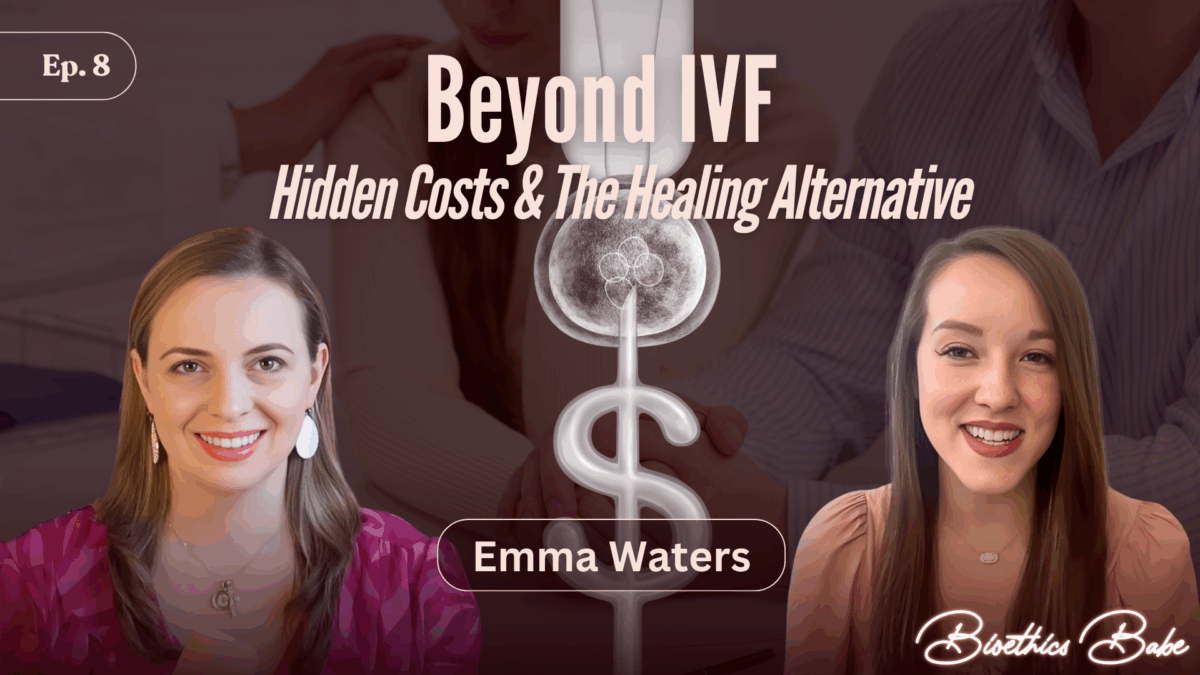
Episode 8 Thumbnail

Inside the IVF Industry: The Hidden Costs of Creating Humans in a Lab and the Restorative Alternative with Emma Waters

In this powerful episode of Bioethics Babe, Emma Waters, a policy analyst at the Heritage Foundation’s Center for Technology and the Human Person, joins Arina Grossu Agnew to unpack the hidden costs of in-vitro fertilization (IVF) and the ethical questions surrounding the fertility industry. While IVF is often hailed as a miracle solution for infertility, few people stop to ask what’s lost when life begins in a lab instead of the womb. Emma explains why IVF bypasses the real causes of infertility, the moral and physical risks it poses, and how Restorative Reproductive Medicine (RRM) offers a healthier, more human-centered alternative that heals the body rather than replacing it. We discuss: If you’ve ever wondered what IVF means for medicine, Read More ›

process-of-in-vitro-fertilization
Image Credit: Andriy Bezuglov - Adobe Stock

IVF Isn’t the Pro-Life Option for Addressing Fertility Issues

A bill proposed by Sen. Tammy Duckworth, D-Ill., is far too extreme since it contains a sweeping definition of "assisted reproductive technology," which goes beyond the deregulation of the IVF industry, and would legalize human cloning, surrogacy, gene editing, human-animal chimera hybrids, and other abuses of human embryos. Read More ›