Humanize From Discovery Institute's Center on Human Exceptionalism
Topic

animal testing

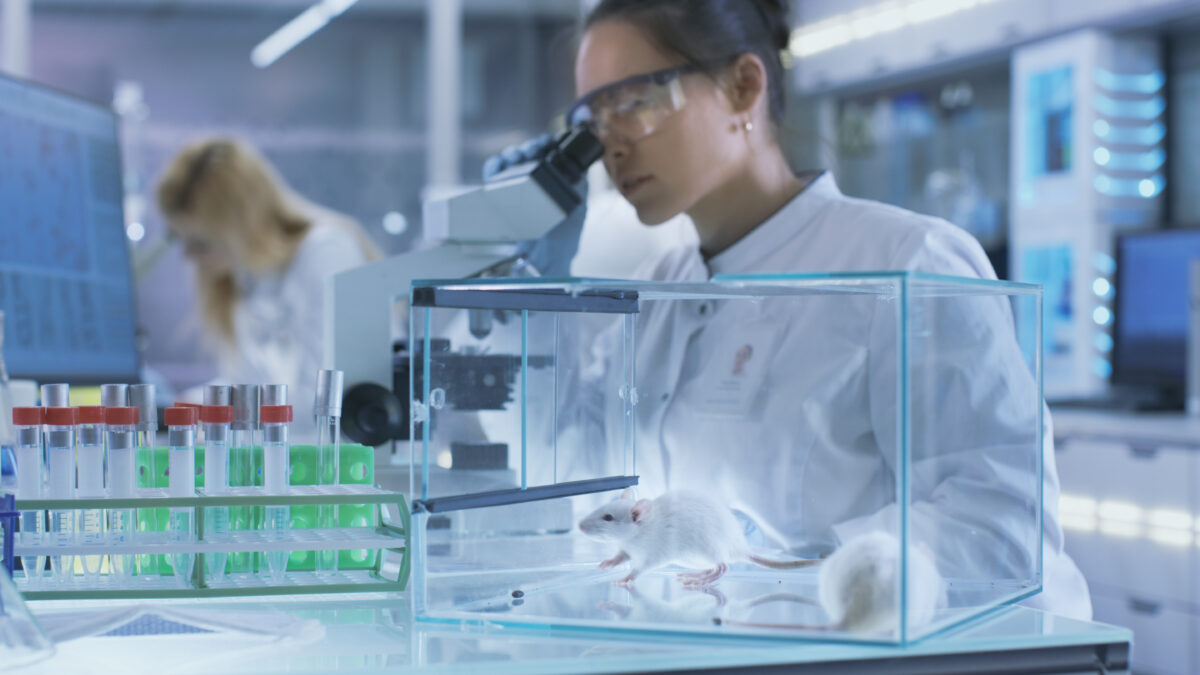
medical-research-scientist-examines-laboratory-mice-and-look-166977106-stockpack-adobestock
Medical Research Scientist Examines Laboratory Mice and Looks on Tissue Samples under Microscope. She Works in a Light Laboratory.
Image Credit: Gorodenkoff - Adobe Stock

For MAHA’s Sake Don’t Eliminate Animal Research

Secretary of Health and Human Services Robert F. Kennedy Jr. made big news recently when he declared that he wanted to eliminate federal funding for research on primates and eventually end all government support for animal experimentation. RFK Jr. says he’ll work with federal agencies to wind down animal testing. One can certainly understand his reasons. Animal suffering makes anyone with a conscience flinch in empathetic revulsion.

But scientists do not engage these methodologies out of sadistic purpose. Rather, their goals are to find new medical treatments, cure diseases, and generally reduce human (and animal) suffering. Indeed, without animal research, the many medical and veterinary advances achieved since World War II would have been impossible. That is why we must think about this important moral issue and not just “feel.”

Most animal work involves basic research—investigations about how bodily systems function. Here’s the story of just one such use that resulted in tremendous reduction in human suffering.

Years ago, Dr. Edward Taub hypothesized that brain function could exhibit greater plasticity than then believed. To determine whether he was right, the nerves in monkeys’ forelimbs were severed surgically. Taub’s purpose was to train the animals to reuse their numb forelimbs; research he hoped would prove valuable in ultimately rehabilitating human stroke patients.

Read More ›
woman-veterinarian-holding-a-little-macaque-monkey-in-the-mo-361977048-stockpack-adobestock
Woman veterinarian holding a little macaque monkey in the monkey cage.
Image Credit: Achirawich - Adobe Stock

RFK Jr. Should Not Eliminate Research on Primates

I rise to second the opinion of neurologist and university professor Cory Miller, published here on NRO, opposing Secretary of Health and Human Services Robert F. Kennedy Jr.’s apparent intention to end all research on primates at the Centers for Disease Control and Prevention. Miller writes:

Reports that the Centers for Disease Control and Prevention (CDC) plans to end research involving monkeys — a move framed as modernization — strikes at the heart of America’s biomedical capacity at the very moment global competitors are expanding theirs.

This is the latest step in Health and Human Services Secretary Robert F. Kennedy Jr.’s plan to phase out animal research in the U.S., an ideologically driven effort that sidesteps scientific evidence by exploiting our understandable desire to reduce animal suffering. And make no mistake, ending research with monkeys is not the end goal. It is only the beginning.

Yes, we should reduce animal testing as much as is practicable. But we should use alternatives, as Miller puts it, as a “complement” to animal studies, not a total replacement. Sure, using animals to test cosmetics and the like can probably be eliminated safely. And by all means, use cell lines, AI computer programs, and other alternatives as much as possible to reduce animal use, consistent with protecting human safety.

Read More ›
common-house-mouse-looks-out-from-a-mink-in-the-wall-stockpack-adobe-stock
Common house mouse  looks out from a mink in the wall
Image Credit: Irina K. - Adobe Stock

About Those ‘Synthetic Embryos’

Israeli researchers appear to have created what they are calling “synthetic mouse embryos,” using embryonic stem cells — without fertilization — and developed them about halfway through a normal mouse period of gestation. Read More ›
Wuhan_Institute_of_Virology_main_entrance

Stop ‘Outsourcing’ Unethical Science to Other Countries

It is long past time for an ethical house cleaning. Overseas breaches of moral propriety by U.S.-funded researchers, domestic companies, and American scientists make us all complicit in wrongdoing. It doesn’t have to be that way. If we close the door on outsourcing ethics, maybe those poor beagl Read More ›
Russian-Chinese_talks._With_President_of_China_Xi_Jinping

It’s Not Just COVID: China’s Dubious Scientific Ethics

China has become the world capital of ethically dubious scientific research. Perhaps even that is too tactful. More accurately stated, China is the land where science ethics go to die. Read More ›
Dripping reagent into test tube with liquid sample, closeup. Laboratory analysis

Animal Testing Discovers New Antibody Component for Fight Against COVID

The animal-rights movement lies when it claims that research using animals offers no human benefit. But the propaganda is having an impact. According to Gallup, a whopping 39 percent of Americans believe that animal research is not moral, versus 56 percent who think it is. In 2019, only 51 percent found it moral. Read More ›