Humanize From Discovery Institute's Center on Human Exceptionalism
Topic

euthanasia

nurse-consoling-her-elderly-patient-by-holding-her-hands-sto-264619531-stockpack-adobestock
Nurse consoling her elderly patient by holding her hands
Image Credit: pikselstock - Adobe Stock

Will We Care For or Kill Dementia Patients?

I understand that people are terrified of dementia. Believe me, I get it. My mother died of Alzheimer’s. But I can’t wrap my head around the fact that advocacy for killing/suicide as the answer to the difficulties caused by the condition is becoming ubiquitous. Noted bioethicist and lawyer Thaddeus Mason Pope has written an essay, to be published in an edited volume, on this very issue. It lists eleven ways people can “avoid late-stage dementia,” and almost all involve intentionally ending life. Remember when we were told that advance medical directives are the key to not receiving life-extending treatment one does not want? They are, but that’s not good enough for Pope, because it doesn’t guarantee death: This strategy is Read More ›

als-person-working-on-memory-and-coordination-skills-stockpa-1536604021-stockpack-adobestock
ALS person working on memory and coordination skills
Image Credit: Sheila - Adobe Stock

Wielding ALS Suffering to Expand Assisted Suicide into Euthanasia

ALS is a catastrophic terminal disease that, within a few years of diagnosis (the physicist Stephen Hawking was an exception), eventually causes total paralysis. It is also a tragic condition that euthanasia/assisted suicide activists zealously wield to justify killing as an acceptable answer to suffering.

Now, the understandable fear of ALS is being deployed by academic advocates as a means of breaking the (U.S.) requirement for a six-month terminal diagnosis and self-administration in assisted suicide.

In jurisdictions where MAiD [the euphemism for assisted suicide that seeks to turn life-ending it into a medical “treatment”]is legally available, such laws are intended to support patient autonomy and alleviate suffering. However, for patients with ALS, the clinical reality of progressive paralysis combined with legal requirements for self-administration of lethal medication creates a cruel dilemma. Approximately one-third of affected individuals express interest in MAiD if their suffering becomes intolerable [12], yet current laws require that it be initiated while patients retain the physical ability to self-administer the prescribed medication.

However, patients are not legally eligible to access MAiD until it is determined they have a life expectancy of six months or less. This creates a narrow and clinically unrealistic window where waiting until they meet legal eligibility may mean they are no longer physically capable of completing the required act, regardless of prognosis, suffering, or intent.

Read More ›
woman-exercising-in-a-park-with-a-friend-providing-support-w-600090291-stockpack-adobestock
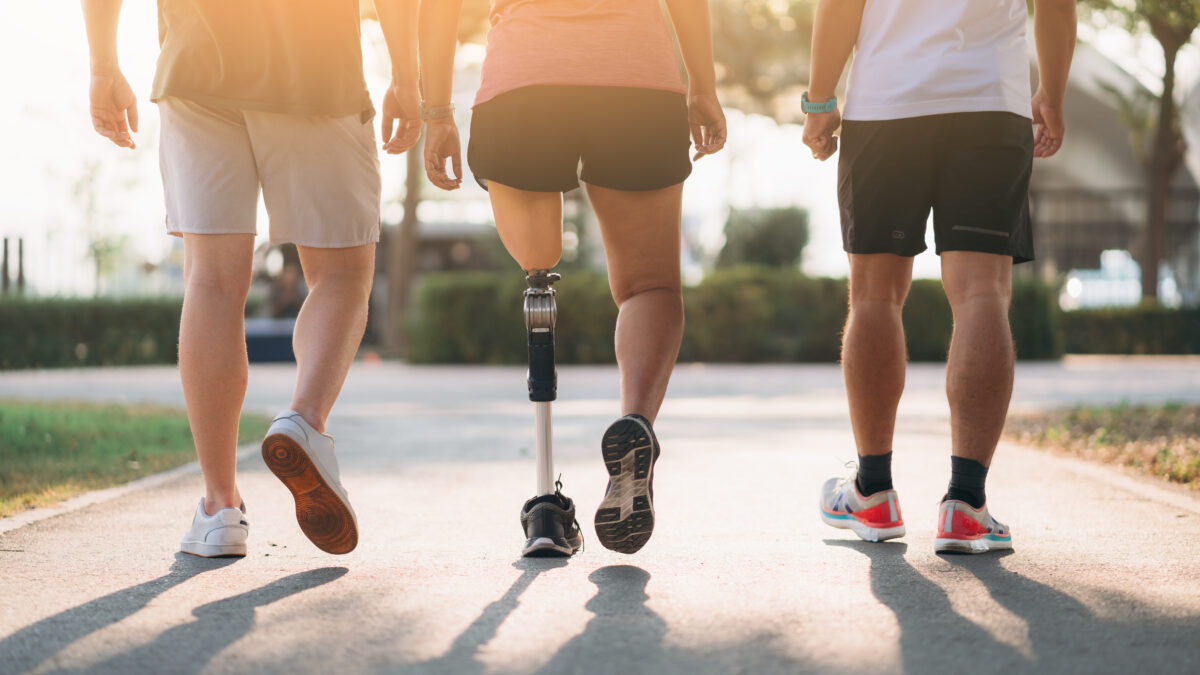
Woman exercising in a park with a friend providing support while using a prosthetic leg. People jogging side by side outside in a park. Female walking and exercise works out outside.
Image Credit: NewSaetiew - Adobe Stock

“Transableism” Comes After Transgenderism

People sometimes tell me that nothing can be more extreme than the transgender craze. I disagree. The next step is already in sight, what is sometimes called “transableism.” Transableism is an advocacy term for a mental illness known as Body Identity Integrity Disorder (BIID). People with the condition anguish that they were born with body parts or capacities that they should not have. This may express as an obsession to become an amputee or paraplegic, as just two examples. Here is an extreme case from the U.K. as reported by the Daily Mail: A surgeon with a “sexual obsession” for cutting off parts of his body had his own legs amputated as part of an insurance scam, officials in the UK said Read More ›

legs-of-a-newborn-baby-lying-in-a-couveuse-the-child-has-jus-238454254-stockpack-adobestock
Legs of a newborn baby lying in a couveuse. The child has just been born and is in the hospital clinic with his mother. Natural childbirth. Cesarean section.
Image Credit: Maryna - Adobe Stock

The Netherlands Already Allows Infant Euthanasia

An article in the Daily Mail sounds the alarm that permitting infant euthanasia — i.e., infanticide — is under serious consideration in Canada: Canada‘s assisted suicide laws have continued rapidly expanding in recent years, with a group of doctors now pushing for disabled newborn babies to be euthanized.…As assisted deaths have become a major part of Canada’s health care system, the Quebec College of Physicians suggested legalizing euthanasia for infants born severely ill. Canada has jumped so enthusiastically into the euthanasia abyss that I have little doubt that infanticide will eventually be allowed there. It’s only logical. If killing is an acceptable answer to suffering, why limit the killing to adults? Besides, as the story briefly notes, the Netherlands already Read More ›

depression-grief-or-fail-with-a-mature-doctor-in-a-hospital-663223192-stockpack-adobestock
Depression, grief or fail with a mature doctor in a hospital looking unhappy for healthcare or medical. Stress, mistake or loss with a sad man medicine professional in a professional medicare clinic
Image Credit: N Felix/peopleimages.com - Adobe Stock

Attacks on Medical Conscience Would Force Doctors to Take Human Life

Legalizing euthanasia/assisted suicide, abortion, and transgender interventions for dysphoric children is only the beginning of the ongoing destruction of Hippocratic moral values in medicine. Once such interventions are legal, activists next insist that they become readily available. But many (and I hope most) doctors want nothing to do with causing death or interfering with the normal functioning of healthy bodies. Indeed, many assisted suicide, abortion, and gender ideologues complain that too few doctors willingly participate in these procedures, as is sometimes protected by the law. These “medical conscience” rights inhibit the increasing hegemony of utilitarian medical values in health care. As a result, once life-taking or mutilating procedures become legal, efforts soon begin to conscript unwilling medical professionals into performing Read More ›

the-bernardine-church-and-monastery-church-of-st-andrew-in-l-133726599-stockpack-adobestock
The Bernardine church and monastery (church of St. Andrew) in Lviv, Ukraine. Church and fortification was built in 1600-1630. Beautiful stained glass window with sunlight. Religion and art concept.
Image Credit: kavunchik - Adobe Stock

Wesley J. Smith to Pro-Life Movement: Save Lives, Not Souls

Wesley J. Smith recently participated in a Symposium hosted by the Human Life Review. He was asked to react to the following statement: In the decades between Roe v. Wade and Dobbs, most prolifers believed that Americans were more or less opposed to legalized abortion on demand because a) this was the case in 1973; b) it was imposed on us from above by “raw judicial power,” rather than legislated; and c) surveys repeatedly showed substantial percentages of Americans being disquieted by abortion, especially when you got beyond the hard cases and the earliest weeks of pregnancy. In the first year or so following Dobbs, prolifers got a reality check through legislative defeats even in some reddish and purple states. We can say (what is true) that massive Read More ›

Screenshot-2025-06-05-112614

Wesley J. Smith Discusses the Spread of Euthanasia on the Ann and Phelim Scoop

Wesley J. Smith appeared on the Ann and Phelim Scoop, hosted by Ann McElhinney and Phelim McAleer, to discuss the spread of euthanasia through the West. Comparing it to a metastasizing cancer, Wesley casts light on why euthanasia has become so popular, the state of euthanasia in Canada, the real reasons people seek euthanasia, and its devastating effects on human life.

Screenshot-2025-05-15-103020

Wesley J. Smith at Wisconsin Right to Life: There Is No Such Thing as a “Little” Assisted Suicide

On April 3, 2025, Wesley J. Smith gave a presentation to Wisconsin Right to Life. After sharing how a friend’s suicide under the influence of the Hemlock Society propelled him into public opposition of the euthanasia movement, Smith explores the personal and societal consequences of embracing assisted suicide.

a-hand-in-a-medical-glove-draws-liquid-from-an-ampoule-from-699951526-stockpack-adobe_stock
a hand in a medical glove draws liquid from an ampoule from a syringe with a needle
Image Credit: kazakova0684 - Adobe Stock

Ten Euthanasia Stories That Caught My Eye

I always enjoy Kathryn Lopez’s ongoing Corner feature in which she posts about news stories that “caught my eye.” So I decided to blatantly steal the concept to discuss euthanasia/assisted suicide stories that have recently been in the news.

  1. A Spanish father lost a legal case to prevent his daughter’s euthanasia. The young woman, who has a severe mental illness, tried to commit suicide previously by jumping off a building, leaving her with paraplegia. A court has now decided, in a bitter irony, that due to her disability, doctors can finish what she started. Awful.
  2. Euthanasia killings in the Netherlands increased by 10 percent between 2023 and 2024, with nearly 10,000 killed by doctors in one year. Lethal jabs for the mentally ill also increased to 219, and 427 dementia patients. There were also 54 reported cases of simultaneous euthanasia deaths of family members. The report doesn’t say how many of these people were organ-harvested.
  3. Nearly 4,000 Belgians were euthanized in 2024. According to the Brussels Times, “The vast majority of patients experienced both physical and psychological suffering (82%). Just under 16% experienced only physical pain and 1.9% psychological suffering.” Belgium was also a euthanasia tourism destination, with 120 people traveling to Belgium from other countries to be killed.
Read More ›
Screenshot 2025-03-13 163251
Screenshot from Illinois Right to Life video: https://www.youtube.com/watch?v=FkRODr_BfmE

Bobby Schindler on the 20th Anniversary of the Death of Terri Schiavo

For those who may not remember, Terri Schiavo was a profoundly cognitively disabled woman who became the subject of a legal and cultural battle that made international headlines. The case became a bitter and protracted conflict between Michael Schiavo, Terri’s husband who wanted to pull her feeding tube, and the Schindler family that fought to save their child and sister’s Read More ›