Humanize From Discovery Institute's Center on Human Exceptionalism
Category

Bioethics

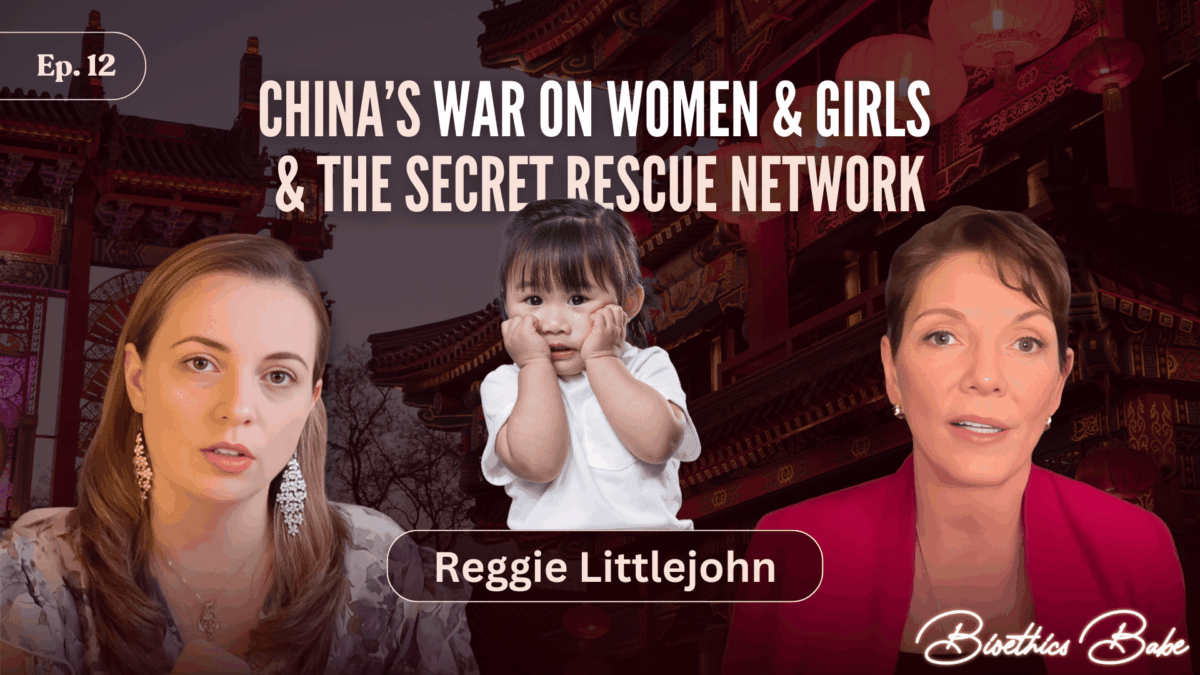
Episode 12 Thumbnail (3)

Inside China’s War on Women and Girls: Forced Abortion, Gendercide, and How One Woman Built a Secret Rescue Network with Reggie Littlejohn

What’s really happening to women and girls in China? In this episode, I sit down with Reggie Littlejohn, Yale-trained attorney and founder of Women’s Rights Without Frontiers, to expose what many experts call the greatest crime against women in the world. Women’s Rights Without Frontiers is a global coalition fighting to end forced abortion, gendercide, and sexual slavery in China. Reggie is widely recognized as an international expert on China’s One-Child Policy—now the Three-Child Policy. Reggie is also the founder and president of the Anti-Globalist Alliance, an international counterforce to the Great Reset, and the co-founder of the Sovereignty Coalition, a non-partisan movement dedicated to defending U.S. national sovereignty and personal medical freedom against threats both foreign and domestic. For Read More ›


doctor-or-surgeon-in-blue-uniform-holding-surgical-knife-or-586774259-stockpack-adobestock
Doctor or surgeon in blue uniform holding surgical knife or scalpel to do surgery inside operating room in hospital under surgical lamp.People pick up surgical blade with white clean space.
Image Credit: Issara - Adobe Stock

Purchasers of Black-Market Human Organs Often Complicit in Murder

The black market in human organs does not receive nearly enough attention. China is probably the worst offender here, with political prisoners like Falun Gong practitioners and Uyghur Muslims arrested, tissue-typed, killed, and harvested to supply well-off buyers who don’t want to wait in the donation queue. We are far too nonchalant about that murderous commerce. Now, a gruesome story out of Nigeria vividly illustrates the sheer evil of this trade in human tissues. From the Daily Mail story: Over 100 decomposed and mutilated bodies have been discovered in a suspected illegal organ-harvesting slaughterhouse in Nigeria. Police have sealed off a hotel and private mortuary in the Umuhu autonomous community in Ngor-Okpala district in southeast Nigeria’s Imo state following a Read More ›

Episode 10 Thumbnail-2

The Lie of Modern Feminism: What Early Feminists Really Believed with Erika Bachiochi

When you hear the word feminism, what comes to mind? This episode launches a multi-part series digging into the real history of feminism: what the early feminists actually believed, how modern feminism drifted, and the bioethical fallout in the realms of sex, contraception, abortion, and women’s place in society. In this powerful conversation, legal scholar, mother of seven, and one of the most compelling voices speaking into women’s rights Erika Bachiochi uncovers the forgotten roots of the early feminist movement. These women understood something our culture has lost: that equality is something deeper than sameness, and freedom isn’t about escaping responsibility. They believed in a moral vision rooted in human dignity, virtue, and the profound responsibilities that emerge from sex, Read More ›

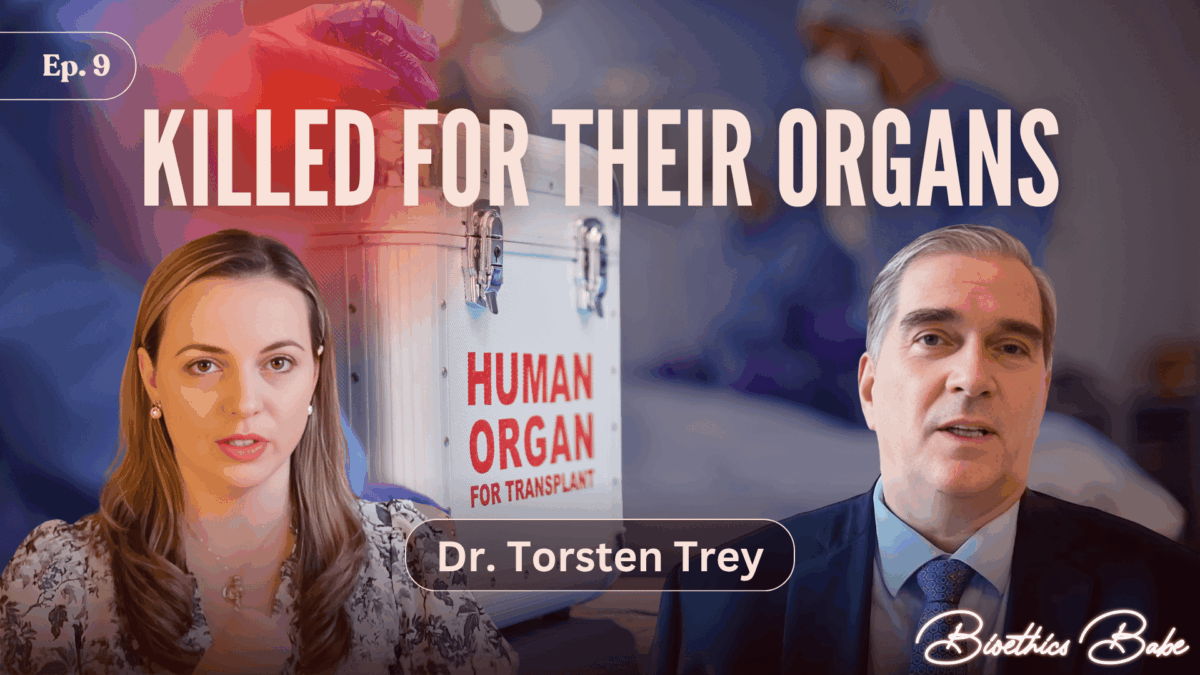
Episode 9 Thumbnail (4)

Killed for Their Organs: Inside China’s Forced Organ Harvesting Genocide with Dr. Torsten Trey

In China, they’re killing people for their organs. China’s secret, state-run forced organ-harvesting genocide is bigger, darker, and more gruesome than anyone could imagine. In this explosive interview, Dr. Torsten Trey, Founder and Executive Director of Doctors Against Forced Organ Harvesting (DAFOH), exposes how Falun Gong practitioners became the CCP’s largest pool of victims with millions detained since 1999. They’re blood-tested in custody not for their health, but to match their organs to waiting buyers. Dr. Trey reveals how China built an on-demand transplant system, where organs — even hearts — appear within days. The only way that’s possible is if living prisoners are being killed to order. He walks us through the massive surge in transplants after 1999: internal Read More ›

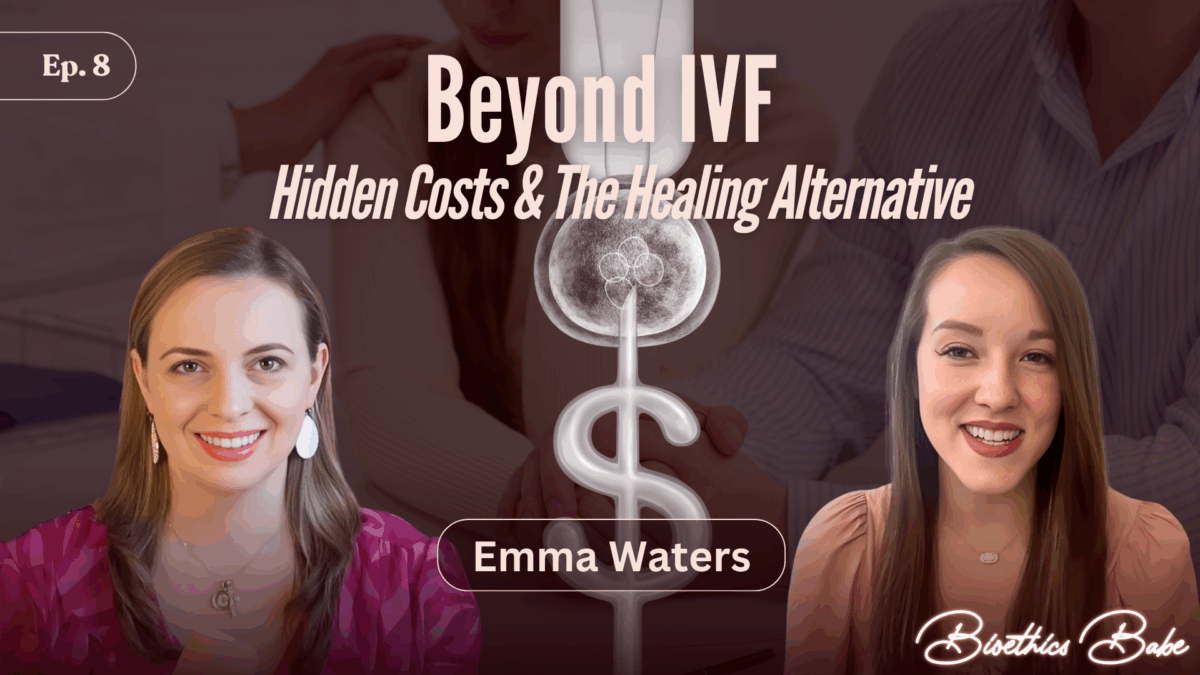
Episode 8 Thumbnail

Inside the IVF Industry: The Hidden Costs of Creating Humans in a Lab and the Restorative Alternative with Emma Waters

In this powerful episode of Bioethics Babe, Emma Waters, a policy analyst at the Heritage Foundation’s Center for Technology and the Human Person, joins Arina Grossu Agnew to unpack the hidden costs of in-vitro fertilization (IVF) and the ethical questions surrounding the fertility industry. While IVF is often hailed as a miracle solution for infertility, few people stop to ask what’s lost when life begins in a lab instead of the womb. Emma explains why IVF bypasses the real causes of infertility, the moral and physical risks it poses, and how Restorative Reproductive Medicine (RRM) offers a healthier, more human-centered alternative that heals the body rather than replacing it. We discuss: If you’ve ever wondered what IVF means for medicine, Read More ›

asian-scientist-pipetting-at-a-biomedical-laboratory-stockpa-245463907-stockpack-adobestock
Asian Scientist Pipetting at a Biomedical Laboratory
Image Credit: shoenberg3 - Adobe Stock

China Jumps on the Transhumanism Train

Transhumanism offers a (delusional, in my opinion) hope to blaze a materialistic path to immortality. Transhumanists yearn, for example, to upload their minds to computers, thinking that will do the trick. It won’t. Even if the “mind” could be uploaded, it would merely be software that mimicked a person’s beliefs. The “uploaded” subject would still be dead.

Now, according to an interesting story in the New York Times, China has apparently jumped onto this longevity train and is devoting much energy and many resources to the life-extension project:

China, eager to catch up with and, whenever possible, surpass the West in biotech, artificial intelligence and other advanced technologies, has made the longevity industry a national priority, pouring billions into research and related commercial spinoffs.

“They have improved very rapidly. A few years ago, there was nothing here and the West was still far ahead,” said Vadim Gladyshev, a Harvard Medical School professor who has done pioneering work on longevity, including an experiment that extended the expected life span of old mice by connecting their circulatory systems to young mice.

Chinese researchers, he said during a recent trip to China to attend two scientific conferences, “are rapidly catching up.”

Well, that sounds ominous. Are we really going to use the blood of the young to keep the old from dying? Why, yes. Some of the hyper-rich in Silicon Valley are already doing that, including Larry Ellison, who receives blood transfusions from his son. Imagine the exploitive possibilities!

Read More ›
Episode 7 thumbnail-2

The Social Transition Trap: A Pediatrician Exposes the Hidden Risks to Kids with Sexual Identity Disorder with Dr. Michelle Cretella

We’re told that changing a child’s name, pronouns, and identity is an act of love, but what if that so-called “affirmation” is actually the start of a dangerous medical experiment? Pediatrician, researcher, former Executive Director of the American College of Pediatricians (ACPeds), and the current Chair of the ACPeds Adolescent Sexuality Committee, Dr. Michelle Cretella says social transition isn’t harmless—it can confuse children when they are not being told the truth about their identity as male or female, disrupt their normal development, and lead them down the path of chemical and surgical interventions. On this episode of the Bioethics Babe Podcast, we’re identifying the hidden risks of social transition in children—and asking the hard questions no one else will. Are Read More ›

Episode 6 thumbnail (1)

The Science of Fertility: Rethinking Women’s Reproductive Health with Dr. Marguerite Duane

Did you know that a woman can only get pregnant a few days each month — and that her body gives her clear signs of when those days are? In this episode of The Bioethics Babe Podcast, Dr. Marguerite Duane, board-certified family physician and co-founder of FACTS About Fertility, reveals the science behind fertility awareness and restorative reproductive medicine. Dr. Duane shares how a night hospital shift changed her entire understanding of women’s health, why fertility awareness is not the old “rhythm or calendar method,” and how tracking a woman’s natural biomarkers — like cervical fluid, basal body temperature, and hormone levels — can help women and couples understand their fertility, address root causes of reproductive health issues, and move Read More ›

senior-patient-and-nurse-in-hospital-stockpack-adobe-stock-274229642-stockpack-adobestock
Senior patient and nurse in hospital
Image Credit: pikselstock - Adobe Stock

Why Bioethics Matters More Than Ever in Modern Medicine

Researchers at Oregon Health & Science University have developed functional eggs from human skins cells. The global genome editing market is set to grow from $6.2 billion in 2025 to $19.6 billion by 2032. We live in an age of astonishing medical breakthroughs. From artificial intelligence in diagnostics to cutting-edge fertility treatments, science seems to advance at breakneck speed. But amid all the excitement, one critical question risks being drowned out: just because we can do something, does that mean we should? That’s the question at the heart of bioethics—the discipline that applies moral reasoning to all kinds of ethical questions. I launched the Bioethics Babe podcast to examine the tough questions and human flourishing in light of science, faith, Read More ›

gavel-on-desk-symbolizing-medical-law-and-justice-with-healt-1695579369-stockpack-adobestock
Gavel on desk symbolizing medical law and justice with healthcare professionals in background
Image Credit: Meow Creations - Adobe Stock

Bioethics Is Not a “Moral Tradition”

Public-advocacy-focused secular bioethics is largely progressive politics covered with a veneer of expertise. While there are certainly university courses and degrees in the field, no bioethicist is licensed as such. Indeed, the entire discourse is purely subjective. It is driven mostly by philosophers, professors, doctors, and lawyers who opine about a particular set of issues, your faithful correspondent included.

But now, members of the tribe apparently want to pretend that secular bioethics has become such a deeply ingrained part of our societal bedrock that it qualifies as a moral tradition. From, “Bioethics as an Emerging Moral Tradition and Some Implications for Adversarial Cooperation,” published in the influential Journal of Medical Ethics (citations omitted):

In a forthcoming book titled The Emerging Tradition of Secular Bioethics,…we focus on whether the field of bioethics in the pluralistic and increasingly polarised American context can give justified moral guidance in foundational, clinical, research and public health domains. We argue against a proceduralistic account of bioethics that limits the field to analysing moral problems and clarifying key concepts but never offering substantive moral guidance. We also reject an Enlightenment account of bioethics based on universal, neutral and abstract rational standards and moral first principles that are undeniable by any reasonable person and that can (in theory) eliminate all fundamental moral disagreements. Rather, we argue that while once naming a discourse through which various historically embedded moral traditions could discuss ethical challenges, bioethics is now an emerging content-full moral tradition in its own right.

Notice that the entire premise excludes the moral influence of religion — which is a much deeper tradition with a far longer history — even though one of the founding fathers of bioethics was the great Christian theologian Paul Ramsey. Moreover, some of the most vibrant minds arguing against contemporary mainstream views — such as the astute Catholic bioethicist Charles Camosy (among many others) — would seem, by definition, to be excluded from the supposed “moral tradition” because their principles are profoundly influenced by faith. (For those who would applaud, please recall that eugenics was a progressive secular policy resisted most vociferously by the Catholic Church.)

Read More ›