Humanize From Discovery Institute's Center on Human Exceptionalism
Author

Wesley J. Smith

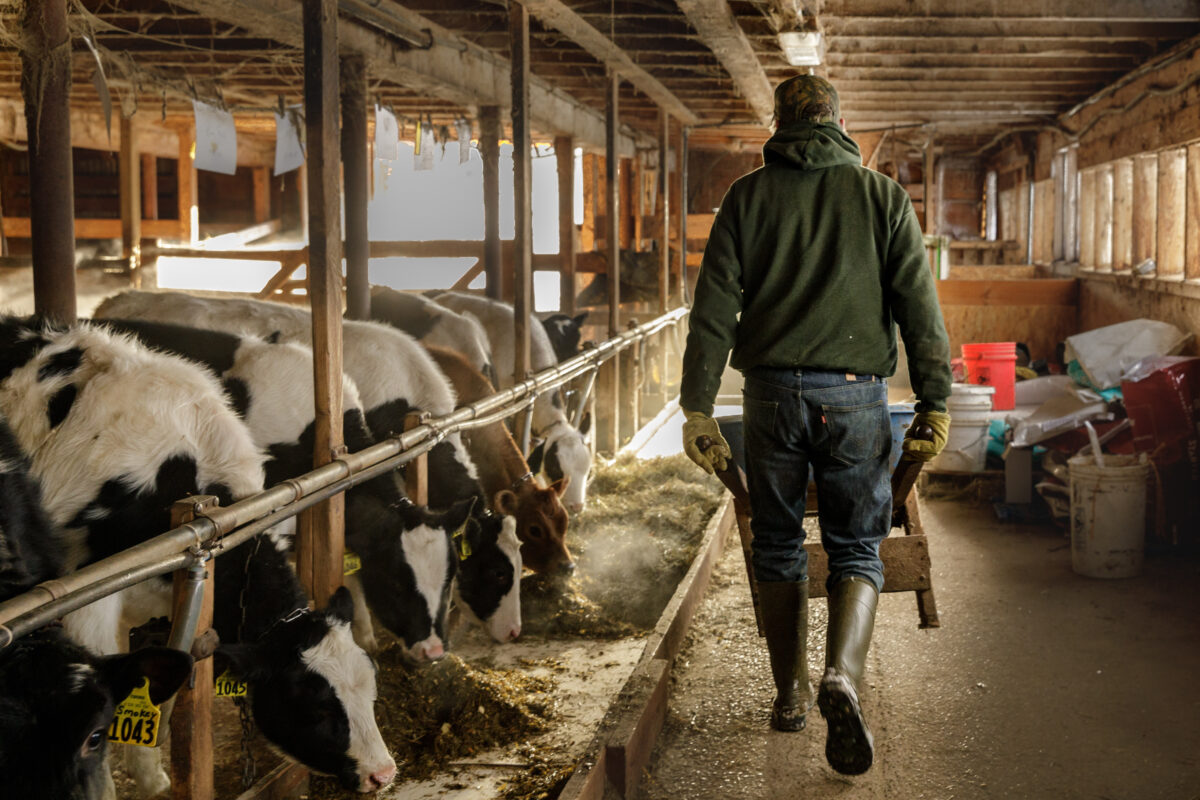
farmer-in-tie-stall-stockpack-adobe-stock-244597911-stockpack-adobestock
Farmer in Tie Stall
Image Credit: Annora - Adobe Stock

Proposed Oregon Initiative Would Outlaw Animal Agriculture and Hunting

Animal rights activists pretend to be about animal welfare, but in reality, they want to outlaw all instrumental uses of animals.

We can see this illustrated in Oregon, where animal rights activists are attempting to qualify Initiative Petition 28 for the November ballot. Proponents claim it is about ending cruelty. But the actual purpose is to effectively outlaw animal agriculture and hunting in the state.

First, if passed, the law would create a legal equality between animals and people. From the Yes on IP28 website:

We believe everyone should be equally protected under the law, and that all animals deserve equal consideration, regardless of whether or not we consider them our companions. All animals deserve a life free from cruelty.

Read More ›
embryo-development-examination-microscopes-enable-studying-t-643751207-stockpack-adobestock
Embryo development examination: Microscopes enable studying the proces
Image Credit: luchschenF - Adobe Stock

NIH Bans Funding of Fetal Tissue Research

After restricting funding for primate research for ethical reasons, the National Institutes of Health has followed up by banning funding of fetal tissue research. From the NIH press release:

The National Institutes of Health (NIH) today announced a new policy ending the use of human fetal tissue in NIH-supported research, marking a significant milestone in the Trump Administration’s efforts to modernize biomedical science and accelerate innovate.

Effective immediately, NIH funds will no longer be used to support research involving human fetal tissue from elective abortions. The policy applies across the NIH Intramural Research Program and all NIH-supported extramural research, including grants, cooperative agreements, other transaction awards, and research and development contracts.

We have to remember the gruesomeness of some of this research: For example, the experiments in which the scalps of 20-week aborted fetuses were grafted onto rodents.

Read More ›
an-old-man-in-a-wheelchair-sitting-in-the-hallway-of-a-nursi-858489026-stockpack-adobestock
An old man in a wheelchair sitting in the hallway of a nursing home
Image Credit: Mechastock - Adobe Stock

Australian ALS Patient Denied Disability Support, Chooses Euthanasia

I really do try to write about other issues. But the awfulness keeps on coming. Yesterday, I called attention to the Canadian bioethicist who claimed that lethal jabs are no different than hip replacements. Today, I came across an awful story out of Australia in which Tony Lewis, age 71 and experiencing Motor Neurone Disease — what we call ALS or Lou Gehrig’s disease — has asked for euthanasia because he was denied sufficient financial support for his disability. From the Hello Care report: A Queensland man with Motor Neurone Disease has chosen to access voluntary assisted dying after being denied support through the National Disability Insurance Scheme because of his age, reigniting concerns about Australia’s two-tier approach to disability Read More ›

medical-drip-tubing-and-patient-at-the-hospital-stockpack-ad-226187097-stockpack-adobestock
Medical drip tubing and patient at the hospital.
Image Credit: romaset - Adobe Stock

Canadian Bioethicist: Euthanasia Should Not Be Considered “Special”

Canada has leaped into euthanasia’s moral abyss with a smile on its face. Since 2015, killable categories have expanded dramatically, from those whose death is “reasonably foreseeable” — a category that was already so broad you could drive a hearse through it — to the chronically ill, people with disabilities, the frail elderly, and, starting next year, the mentally ill.

More than 16,000 Canadians were killed by doctors and nurse practitioners last year. It’s the fifth-most-common cause of death in the country.

Many commentators point to these and other facts about Canada’s euthanasia regime to argue against legalization. Defenders of euthanasia know this and have mounted counternarratives trying to convince us that so many killings of such a varied numbers of people is an excellent outcome of a humane policy. The latest example is in the Canadian Journal of Bioethics, in an article by bioethicist and philosophy professor Wayne Sumner, in which he argues that euthanasia should be considered a ho-hum question, nothing to worry about.

Sumner shrugs at the dramatic increase in the numbers killed since legalization because euthanasia is just another medical treatment and should not be considered to be extraordinary. Indeed, to Sumner, doctors’ killing patients is really no different than performing hip replacements. Ditto abortion. And since an increase in abortion rates (to him) is a good, and no one objects to more hip replacements, what’s the problem with the statistical increase in deaths by euthanasia? From “What’s So Special About Medically Assisted Dying?“:

If we regard an increasing number of joint replacements or abortions as success, with supply having risen to meet demand, why should we think that an increasing number of MAiD provisions is a failure, or somehow a problem? If more awareness, more providers, and more support are good things for these other services, why are they a bad thing for MAiD? Why should we think differently about MAiD than we do about other medical procedures? What’s so special about MAiD?

Let me count the ways.

Read More ›
adorable-toddler-girl-in-yellow-dress-and-straw-hat-playing-422476720-stockpack-adobestock
Adorable toddler girl in yellow dress and straw hat playing with goats at farm
Image Credit: Ekaterina Pokrovsky - Adobe Stock

Just Another Animal?

I hate to say this about the work of a fellow author, but The Arrogant Ape (Avery, 336 pp.) is one of the most shallow and impractical books I have ever read. It is not that the author, Christine Webb, can’t write. And it’s not that she did not put much research into her many stories of striking animal behaviors. But her thoughts about what she calls the “myth of human exceptionalism” are mostly mere assertions, such as that Darwinian theory entails her position and the acceptance of human exceptionalism has caused an ecological crisis. But human exceptionalism is no myth. The term conveys two symbiotically related concepts: First, that our lives are of unique equal intrinsic moral value, sometimes Read More ›

rosary-hanging-from-medical-professionals-pocket-outdoors-st-1736651625-stockpack-adobestock
Rosary Hanging from Medical Professional's Pocket Outdoors
Image Credit: Alex Pios - Adobe Stock

Lawsuit in Canada to Force Catholic Hospitals to Permit Euthanasia

Freedom of religion is on the ropes in increasingly authoritarian Canada — despite a specific charter guarantee of “freedom of religion and conscience.” Indeed, an Ontario court ruled previously that doctors can be coerced under threat of professional discipline to perform lethal jabs or abortions against their religious beliefs and conscience objections. Why? The court ruled that the unenumerated right of patients to receive any legal procedure paid for by the government superseded the specific charter protection. If doctors don’t want to kill, the court also ruled, they can either provide an “effective referral” — meaning soliciting a doctor known to be willing to kill — or get out of medicine. Now, in British Columbia, the family of a euthanized woman, who Read More ›

iberian-pigs-in-the-nature-eating-stockpack-adobe-stock-245387466-stockpack-adobestock
Iberian pigs in the nature eating
Image Credit: Sergio - Adobe Stock

Animal Welfare vs. Animal Rights

Vox has published a piece that expresses some surprise at the fact that many conservatives and MAGA (not the same thing) support animal welfare. The writer discusses, among other things, RFK Jr.’s recently announced plan to phase out all government support for animal research:

Over the past decade, it’s been fascinating to see the animal rights movement — which is mostly comprised of left-leaning activists — reckon with the fact that an administration they largely oppose has taken some actions to help animals. Especially on the animal experimentation issue, it’s led to a “diverse, sometimes-uneasy coalition of animal welfare advocates, science reformers, and far-right political figures,” as journalist Rachel Fobar put it for Vox last year. But that coalition, with all its contradictions and disagreements, represents what little hope there is to prevent animal cruelty at the federal level.

The article makes the common media mistake of conflating animal welfare and animal rights. But the two ideological approaches are not the same at all.

Animal rights is an ideology that sees no moral difference between humans and other animals. It claims that rights come from the ability to suffer (“painience”). Since a cow can feel pain, bovines are equal to humans, and cattle ranching is akin to slavery. In other words, animals have the right to never be used instrumentally for any purpose no matter how much it might benefit humankind. Or, as PETA’s leader Ingrid Newkirk infamously once put it, “A rat, is a pig, is a dog, is a boy.”

Read More ›
visualize-a-honeycomb-sphere-with-golden-honey-and-busy-bees-826488003-stockpack-adobestock
Visualize a honeycomb sphere with golden honey and busy bees Highlight its sweet productivity
Image Credit: Lalida - Adobe Stock

Bees Granted Rights in Peru

The rights of nature movement has been more successful than the animal rights movement. Geological features such as rivers, but few animals, have been granted rights. But now in a merger of sorts of these worldviews, stingless bees have been granted rights in two local ordinances in Peru. From the Smithsonian magazine story: Under the new laws, stingless bees now have the fundamental right to exist and flourish in a healthy environment, without pollution, habitat loss, climate change, human activity or other threats getting in the way of their survival. Humans can also file lawsuits on the insects’ behalf. So, in essence, bees have been granted a right to life. PETA must be dancing a jig. Also, notice the global warming Read More ›

medical-research-scientist-examines-laboratory-mice-and-look-166977106-stockpack-adobestock
Medical Research Scientist Examines Laboratory Mice and Looks on Tissue Samples under Microscope. She Works in a Light Laboratory.
Image Credit: Gorodenkoff - Adobe Stock

For MAHA’s Sake Don’t Eliminate Animal Research

Secretary of Health and Human Services Robert F. Kennedy Jr. made big news recently when he declared that he wanted to eliminate federal funding for research on primates and eventually end all government support for animal experimentation. RFK Jr. says he’ll work with federal agencies to wind down animal testing. One can certainly understand his reasons. Animal suffering makes anyone with a conscience flinch in empathetic revulsion.

But scientists do not engage these methodologies out of sadistic purpose. Rather, their goals are to find new medical treatments, cure diseases, and generally reduce human (and animal) suffering. Indeed, without animal research, the many medical and veterinary advances achieved since World War II would have been impossible. That is why we must think about this important moral issue and not just “feel.”

Most animal work involves basic research—investigations about how bodily systems function. Here’s the story of just one such use that resulted in tremendous reduction in human suffering.

Years ago, Dr. Edward Taub hypothesized that brain function could exhibit greater plasticity than then believed. To determine whether he was right, the nerves in monkeys’ forelimbs were severed surgically. Taub’s purpose was to train the animals to reuse their numb forelimbs; research he hoped would prove valuable in ultimately rehabilitating human stroke patients.

Read More ›
medical-professional-carrying-a-cooler-for-organ-transport-s-1068378728-stockpack-adobestock
Medical professional carrying a cooler for organ transport, symbolizing organ preservation and transplantation logistics.
Image Credit: TensorSpark - Adobe Stock

Will Assisted Suicide Coupled with Organ Harvesting Come to the U.S.?

Once someone is considered killable or supported in suicide, they may become objectified so as to be used instrumentally. Such is the case with people requesting to be euthanized. The idea is that they are going to die anyway, want to die — even as they do not receive suicide prevention — so we might as well get good use out of them such as by conjoining their hastened deaths with organ harvesting. This abandonment (in my view) is rife in Canada, where in Ontario, a patient approved for a lethal jab will soon receive a call from the organ procurement society asking for their organs. The Netherlands and Belgium also permit conjoining organ harvesting — including of mentally ill Read More ›